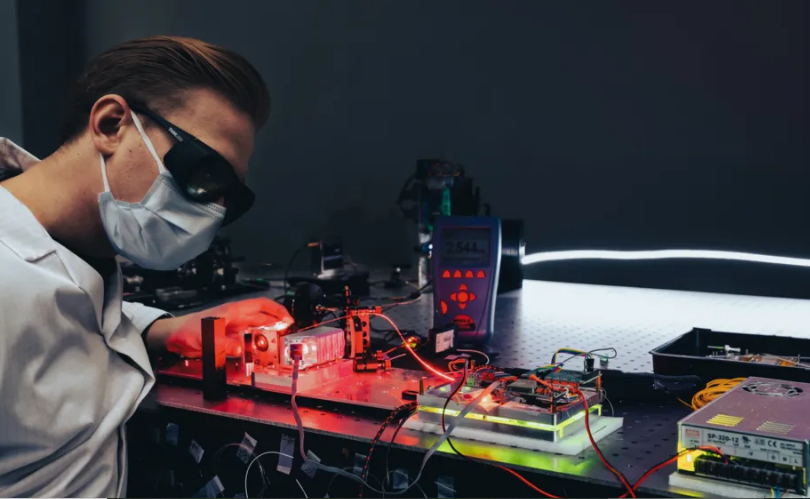
In the heart of Vilnius University’s concrete halls — more Soviet than space-age in appearance — a cutting-edge Lithuanian startup is quietly building a laser-powered revolution in space and defence communications. Astrolight, founded just six years ago, has secured €2.8 million in new funding to develop what it calls an “optical data highway” — a laser communication system linking satellites to Earth.
The concept, likened to invisible internet cables in space, is designed to replace traditional radio frequencies with faster, more secure laser beams. With an estimated 70,000 satellites expected to launch globally in the next five years, the startup sees vast potential in both civilian and military applications.
Astrolight’s lasers have already caught the attention of NATO, which included the firm in its Defence Innovation Accelerator for the North Atlantic (DIANA) programme. The Lithuanian Navy has also turned to the company, seeking a communication solution that works during radio silence. According to co-founder and CEO Laurynas Maciulis, Astrolight adapted its space laser for sea-based use, delivering a secure, low-detectability option that’s difficult to intercept or jam.
“In Ukraine, if you turn on a radio transmitter, you become a target,” Maciulis said. “Our laser beams are so narrow, they’re almost impossible to detect.”
Lithuania, though small in size, punches above its weight in defence innovation. The country spends about 3% of its GDP on defence — a figure set to rise to 5.5% — outpacing larger NATO allies like the UK in relative terms. Around 30% of Lithuanian space projects receive EU funding, nearly double the EU average, with support funnelled through agencies like Space Hub LT.
Lithuania’s expanding space ecosystem includes firms like Blackswan Space, which has developed autonomous satellite navigation capable of repositioning satellites without human intervention. While ideal for the crowded space sector, the technology also has defence uses — including the ability to track or even disable enemy satellites and power military training simulations.
But commercial success hasn’t guaranteed government support. Blackswan’s Chief Commercial Officer Tomas Malinauskas believes funding has not kept pace with innovation. He suggests Lithuania should invest in domestic satellite constellations for communication and intelligence — rather than purchasing foreign drones vulnerable to early destruction in conflict.
Space Hub LT’s Eglė Elena Šataitė agrees that space technologies are now critical to national security. Economy and Innovation Minister Lukas Savickas echoed this, saying space tech offers “horizontal value” across sectors from biotech to artificial intelligence.
For Delta Biosciences, another Lithuanian firm preparing to test radiation-resistant compounds aboard the International Space Station, the drive to innovate has become part of a national mission.
“Everything we do is also geopolitical,” said co-founder Dominykas Milasius. “We have to build technologies that show our allies we’re worth protecting.”
With rising geopolitical tensions and increasing reliance on secure communications, Lithuania’s burgeoning space sector is proving that even small nations can become indispensable players in the global defence and technology landscape.