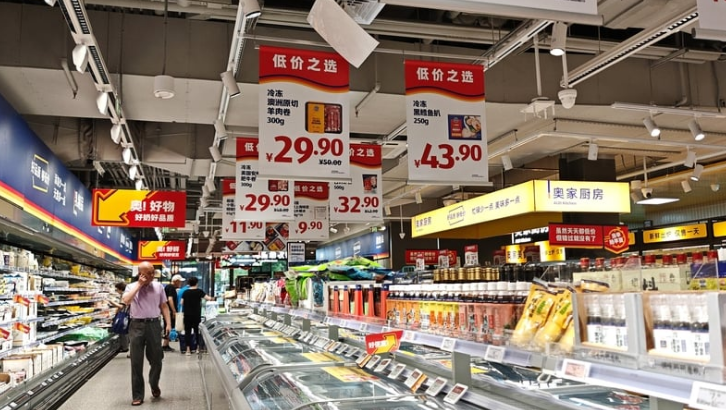
China recorded a slight increase in consumer prices in June, snapping a four-month decline, as authorities continue to battle weak domestic demand and mounting pressure from an escalating trade conflict with the United States.
Data released Tuesday by the National Bureau of Statistics (NBS) showed that the Consumer Price Index (CPI), a key measure of inflation, rose by 0.1% year-on-year in June. The figure marks a modest improvement from May’s 0.1% decline and exceeded the 0.1% drop predicted by a Bloomberg survey of economists.
NBS statistician Dong Lijuan attributed the rise to a rebound in the prices of industrial consumer goods and noted that “policies of expanding domestic demand and promoting consumption continued to be effective.”
Beijing has set an economic growth target of around 5% for 2025, but analysts have expressed skepticism about the feasibility of reaching that goal amid lackluster consumer spending and broader economic headwinds.
To stimulate the economy, China has rolled out a range of policy measures, including interest rate cuts, eased restrictions on home purchases, and a trade-in programme to encourage consumer goods upgrades. Despite these efforts, confidence in key sectors such as real estate remains fragile.
The property market, a traditional engine of growth, remains in crisis following years of overbuilding, stalled projects, and falling prices. “The momentum in the property sector is still weakening,” said Zhiwei Zhang, president and chief economist at Pinpoint Asset Management.
Meanwhile, factory-gate prices continue to fall sharply, signalling ongoing deflationary pressure. The Producer Price Index (PPI), which tracks prices at the wholesale level, fell 3.6% in June compared to a year earlier—the steepest decline in nearly two years. This followed a 3.3% drop in May and outpaced economists’ expectations of a 3.2% decline.
“The deflationary pressure remains significant,” Zhang said, adding that despite the slight CPI rise, it is “too early to call the end of deflation.”
External risks are also mounting. A renewed round of US tariffs unveiled by President Donald Trump is expected to hit Chinese exports just as domestic demand struggles to recover. Trump has imposed steep tariff hikes on various imports, reviving trade tensions that had previously eased.
Zhang warned that the market is underestimating the impact of such tariffs, noting they could significantly harm both the US and global economies.
As China looks to shore up its growth through exports, the headwinds from trade policy, sluggish domestic demand, and deflation continue to pose challenges for policymakers aiming to stabilise the post-pandemic recovery.