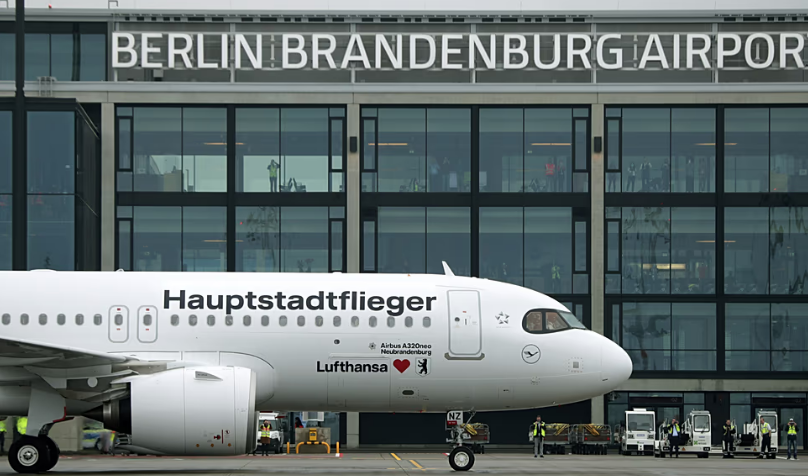
Air traffic at Berlin’s Brandenburg Airport (BER) was brought to a halt for nearly two hours on Friday evening after an unidentified drone breached the airport’s airspace, prompting police intervention and the diversion of several incoming flights. Authorities have launched an investigation into the incident, which officials say highlights growing security concerns across German skies.
Airport officials confirmed that flight operations were suspended from around 8 p.m. to shortly before 10 p.m. after multiple witnesses, including police officers, reported spotting a drone over the airport’s northern runway. A police helicopter was deployed to search for the unmanned aircraft, but its trail eventually disappeared. The Federal Aviation Office has since joined the investigation, which continued late into the night.
Flights Diverted and Operations Extended
The temporary shutdown forced several aircraft to divert to other German cities. Four flights landed in Dresden, another four in Leipzig, and three in Hamburg. The affected flights included arrivals from Stockholm, Antalya, and Helsinki.
To manage the backlog once the airspace reopened, Brandenburg Airport was granted special authorization to extend its operational hours beyond the usual midnight curfew. Departures were permitted until 1 a.m., and landings continued until 4 a.m. — an exception to Germany’s strict night-flight ban.
“Airport operations started as normal this morning,” an airport spokesperson told local media on Saturday. “There are no longer any restrictions for travellers.”
Security Concerns Raised
The German Airports Association (ADV) described the incident as a “wake-up call in terms of security policy.” Managing Director Ralph Beisel warned that the incident not only disrupted air traffic but also risked undermining public confidence in aviation safety.
“When take-offs and landings are stopped and numerous aircraft have to be diverted, it is not only flight operations that suffer — passenger trust in air safety also takes a hit,” Beisel said. He urged the government to take stronger measures to detect and defend against unauthorized drones.
“Airports must not be left alone here. Drone detection and defence are sovereign state responsibilities and must be strengthened comprehensively,” he added.
Recurring Problem in German Airspace
Drone-related disruptions have become increasingly common in Germany. According to German Air Traffic Control (DFS), Brandenburg Airport has already recorded five such incidents in 2025, compared to more than 15 in 2023 and 20 in 2022. Nationwide, DFS logged 144 drone-related obstructions this year, with 35 near Frankfurt Airport alone.
The drones are frequently spotted near airports, military sites, and transport routes, raising potential espionage concerns. Most sightings are reported by pilots or detected by air traffic controllers, with about 90% occurring around major airports.
German Interior Minister Alexander Dobrindt has pledged to accelerate efforts to strengthen the country’s drone defence systems by improving coordination between federal and state authorities, advancing new detection technologies, and integrating police and military responses.