

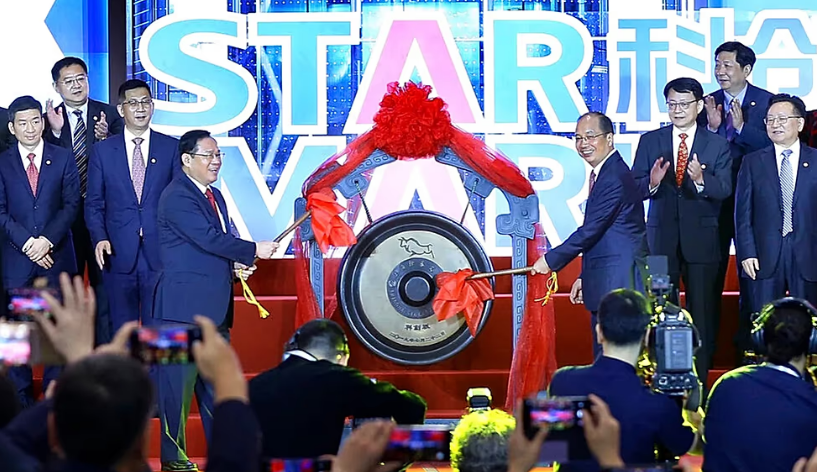
China’s technology sector is experiencing a surge in public market activity as domestic AI ambitions gather pace, fueled in part by U.S. export restrictions. Leading the charge, AI chipmaker Moore Threads soared 425% during its Shanghai debut after raising 8 billion yuan (€970 million), marking one of the largest first-day gains for a major initial public offering in the country.
The offering comes on the heels of reforms to China’s STAR Market, introduced in 2019, which simplified the listing process for high-tech firms. Moore Threads, founded in 2020 by former Nvidia executive Zhang Jianzhong, is considered a second-tier chipmaker, with GPUs that are less advanced and less energy-efficient than those of Huawei’s HiSilicon or leading domestic AI chip designer Cambricon. Despite these limitations, the IPO reflects strong investor appetite for local semiconductor innovation.
The surge in Chinese semiconductor stocks follows stringent U.S. measures restricting advanced chip exports to China. These rules, initiated under the Biden administration, prevent Nvidia, AMD, and other American firms from supplying their most sophisticated AI processors, aiming to slow China’s progress in military AI, cyber capabilities, and mass surveillance. The curbs have largely shut China out of cutting-edge hardware, forcing domestic firms to train and deploy large language models on less capable devices, widening the performance gap with U.S. competitors.
In response, Beijing has accelerated efforts to achieve semiconductor self-reliance. The government has implemented subsidies and emergency financing to encourage domestic firms and tech giants such as Tencent, Alibaba, and ByteDance to reduce reliance on foreign chips. This state support has created a protected home market for Chinese chipmakers, allowing them to focus on local demand and international markets outside the U.S., including the global south.
Analysts note that the current environment mirrors the earlier trajectory of Huawei. U.S. export restrictions initially disrupted production, but Chinese state-backed support and domestic innovation enabled rapid catch-up and substitution. Moore Threads’ IPO is seen as another example of this dynamic, reflecting Beijing’s push to develop a competitive domestic AI hardware ecosystem despite external constraints.
While Moore Threads’ GPUs currently lag those of global leaders, the combination of policy backing, investor enthusiasm, and rising domestic demand is expected to strengthen China’s AI and semiconductor sector over the long term. Investors and analysts are watching closely to see if the government-backed strategy can close the technological gap with U.S. rivals while sustaining the rapid growth of local AI hardware companies.
The IPO and rising valuations underscore a broader trend: U.S. efforts to limit China’s access to cutting-edge technology may be accelerating, rather than slowing, the development of domestic AI capabilities, intensifying the global race for artificial intelligence leadership.