


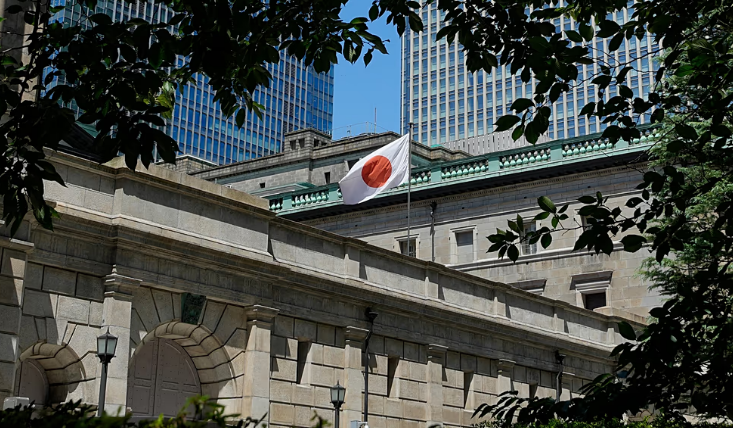
The Bank of Japan announced this Friday that its policy interest rate remains unchanged at 0.75%. The decision comes after a huge sell-off in Japanese bonds this week, triggered by Prime Minister Takaichi’s call for snap elections and unfunded tax cuts that fuelled inflation fears.
The BoJ’s move to hold the headline rate was widely anticipated, giving markets time to absorb last month’s 30-year high increase to 0.75%. The central bank also raised its GDP growth forecast for 2025 to 0.9% and to 1% for the current fiscal year, up from 0.7% previously. Officials said the decision allows the economy to adjust to recent monetary tightening, though it does not fully calm investor concerns over Japan’s debt and political stability.
Japanese bonds suffered a historic rout on Tuesday. The yield on the 40-year government bond exceeded 4% for the first time since 2007, while the 30-year note rose nearly 30 basis points to around 3.9%, the highest on record. The sell-off followed Prime Minister Takaichi’s announcement on Monday of snap elections on 8 February and a pledge to suspend the 8% consumption tax on food for two years. The measure would reduce annual revenue by roughly ¥5 trillion (€31.5bn), intensifying fears about Japan’s debt-to-GDP ratio, which remains near 240%, the highest among developed economies.
Takaichi also unveiled a ¥21.5 trillion (€115bn) spending package, prompting comparisons to the United Kingdom’s 2022 “mini-budget” crisis. Analysts warned that unfunded fiscal stimulus could fuel inflation and drive further volatility in bond markets.
Since taking office in October 2025, Takaichi became Japan’s first female prime minister following the resignation of Shigeru Ishiba. Her ruling coalition, formed with the Japan Innovation Party after losing the upper house majority, now faces snap elections aimed at consolidating a fresh mandate. Takaichi has positioned the proposed food tax cut as a direct transfer to households struggling with inflation, though the policy has so far contributed to higher mortgage rates and borrowing costs.
Market volatility has eased somewhat after government intervention, with Chief Cabinet Secretary Minoru Kihara assuring officials are monitoring bond movements. Still, the 10-year government bond yield remains at around 2.25%, the highest since 1999.
The bond rout also affected global markets, triggering a repricing in US Treasury yields. Japan holds over $1 trillion (€850bn) in US Treasuries, making its fiscal and monetary policies a major factor for international investors. US Treasury Secretary Scott Bessent noted at the World Economic Forum in Davos that market reactions are primarily linked to Japan’s domestic fiscal shift rather than external factors.
Prime Minister Takaichi’s policies, including extensive government spending and tax cuts, are expected to sustain inflationary pressure. Analysts warn this could lead to further BoJ rate adjustments and continued disruption to the long-standing “yen carry trade,” a strategy that has underpinned global investment flows for decades.