

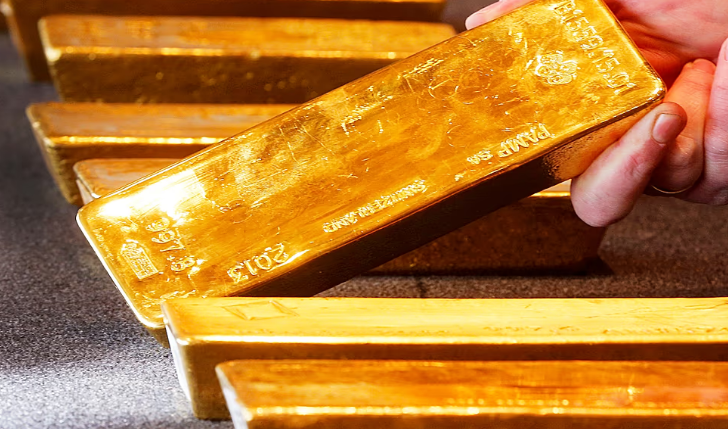
Germany stores 1,236 tonnes of gold in the United States, worth more than €100 billion, sparking renewed debate over whether the reserves should be returned home. The discussion has gained momentum amid tensions over the Trump administration’s trade policies and foreign policy moves, which some European politicians view as unpredictable.
Marie-Agnes Strack-Zimmermann, chair of the Defence Committee in the EU Parliament, argued that it is no longer justifiable to keep such a large portion of Germany’s wealth abroad. “It is worth its weight in gold, literally,” she said, calling for the reserves to be repatriated. Public opinion in Germany appears supportive of the move, and similar debates are taking place in Italy, which has the world’s third-largest gold reserves.
Germany’s total gold holdings amount to about 3,350 tonnes, with roughly 36.6 percent kept in the United States. This arrangement dates back to the Bretton Woods system established after World War II, when exchange rates were tied to the US dollar, which in turn was pegged to gold. “Germany had large export surpluses with the US, so we accumulated a lot of dollars. To keep exchange rates stable, we exchanged those dollars for gold. That’s how these reserves were built up,” said Dr. Michael Demary, senior economist at the German Economic Institute.
Storing gold in the US also made sense during the Cold War, as it offered security against potential conflict with the Soviet Union. Some gold has already been repatriated in recent years. Between 2013 and 2017, the Bundesbank brought back 300 tonnes from New York, 380 tonnes from Paris, and 900 tonnes from London, as part of a plan to hold half of Germany’s gold reserves domestically by 2020.
Despite Strack-Zimmermann’s call, economists warn that moving the gold could carry serious risks. Transporting such a large quantity would require heavily guarded armoured vehicles and ships, and threats could range from theft to accidents at sea. The Bundesbank has historically conducted frequent inspections of its US reserves to ensure security, and keeping the gold abroad also allows Germany to access dollars in case of a domestic banking crisis.
Demary suggested that the push to repatriate the gold may be politically motivated. “Perhaps it was a response to tariff threats, a symbolic move saying, ‘We’re bringing our gold back now,’” he said. He also emphasized that the gold is currently safe in New York. Even in a worst-case scenario where the US refused to release it, Germany could pursue legal avenues to reclaim its holdings or receive compensation in dollars.
Economists conclude that while the idea of bringing the gold home appeals to some politicians and citizens, the practical benefits of leaving it in the US outweigh the risks. The gold remains secure, and repatriation could prove both costly and logistically challenging.