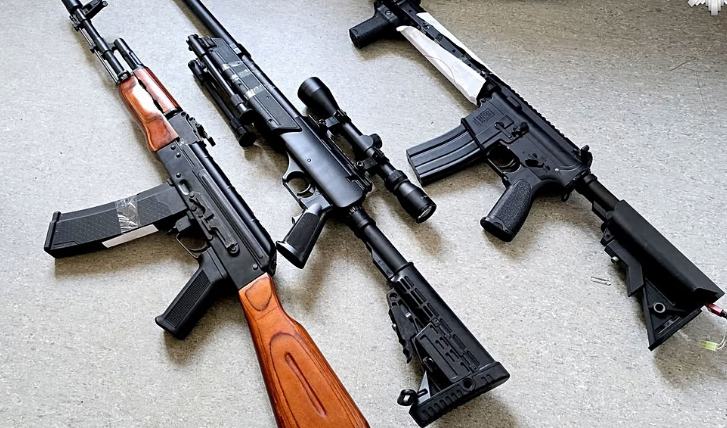
The number of legally owned firearms in Poland surpassed the one million mark for the first time in 2025, according to the latest figures from Polish police. The country issued a record 50,700 gun permits last year, bringing the total number of registered civilian firearms to 1,037,778, an increase of more than 107,000 compared with 2024.
Active permits also climbed, reaching 411,769 by the end of 2025, more than double the 192,819 registered in 2015. Collector permits accounted for the largest share of applications, with 21,071 issued in 2025. Sporting permits followed with 17,601, while 7,254 permits were granted for personal protection.
The surge in firearm ownership began in 2022, when 37,402 new permits were issued compared with 19,939 the previous year. Shooting ranges across Poland reported a spike in visitors in the weeks after Russia’s full-scale invasion of Ukraine in February that year. Despite the increase, Poland has about 2.5 firearms per 100 inhabitants, still the lowest rate in the European Union. By comparison, Finland leads the bloc with 32.4 guns per 100 people, followed by Austria at 30 and Cyprus at 29.1.
Concerns have been raised over the current permit system, which concentrates authority within the police. Dariusz Loranty, a former Warsaw police superintendent, said the system “violates the sacred principle of the separation of powers,” noting that the police both review and approve applications. Loranty proposed transferring permit authority to civil administrations, allowing governors to issue permits with police input and providing a route for judicial review.
Loranty also called for stricter psychiatric assessments, recommending that applicants be evaluated at least twice in different circumstances. He stressed that gun ownership brings a heightened sense of responsibility, noting that Polish law prohibits carrying or using firearms while under the influence of alcohol.
Contrary to popular belief, Loranty said fears of conflict with Russia are not the primary driver behind rising firearm applications. “A very small proportion of people have this delusion,” he said. “In fact, the rationale is that people are afraid of an increase in crime in a broad sense.” He highlighted concerns over Georgian criminal groups as a particular motivation.
Poland 2050, a centrist party in the ruling coalition, submitted draft legislation in October 2025 that would require mandatory medical and psychological checks for all gun permit holders. Under the proposal, applicants up to age 70 would provide certificates every five years, while those over 70 would need checks every two years. Collectors and historical re-enactors whose weapons pose minimal risk would be exempt. The hunting community has opposed the measure, and a similar initiative affecting only hunters was previously rejected by parliament.
Compared with the United States, where firearms exceed 120 per 100 inhabitants, Poland’s gun ownership rate remains low, reflecting the EU’s generally more restrictive regulations. Firearm homicide rates in the US are substantially higher than European averages, underscoring the contrasting approaches to gun policy between the two regions.