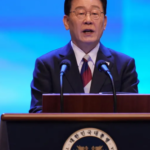


There has been key changes to Iran’s management and defence structure in the wake of a possible war with the United States, according to an article by the New York Times. Iranian leader Ali Khamenei has reportedly delegated responsibility for maintaining the political structure and managing wartime operations to Ali Larijani, the secretary of the Supreme National Security Council.
Since early January, following domestic protests and growing threats from the United States, Larijani, a 67-year-old politician and former commander of the Islamic Revolutionary Guard Corps, has taken control of key national affairs, the newspaper reported, citing six Iranian officials and members of the Revolutionary Guard Corps. The move has resulted in the marginalization of President Masoud Pezeshkian, who continues to emphasize his professional identity as a physician and has avoided direct responsibility for managing macro-crises.
Iranian media quoted by the New York Times indicated that officials, including medical authorities, have increasingly turned to Larijani for guidance on national issues, highlighting his influence in the current leadership structure. Khamenei has instructed Larijani and a circle of military and political loyalists to establish layers of succession for key positions, a precaution designed to maintain the system’s stability in the event of assassination or communication disruptions during wartime.
“The leadership has full confidence in Larijani and considers him a sensitive and critical figure due to his political experience and intelligence expertise,” the report quoted Nasser Imani, an analyst closely aligned with Iran’s principled political spectrum.
The New York Times report also detailed Iran’s defensive preparations amid fears of U.S. military action. According to the article, Iran has deployed ballistic missile launchers along its western borders near Israel and on the southern shores of the Persian Gulf, placing them within range of American bases. All branches of the armed forces have reportedly been placed on the highest state of readiness.
Analysts caution that while Larijani’s elevation ensures operational continuity, the supreme leader remains central to Iran’s political system. Ali Vaez, director of the Iran division at the International Crisis Group, told the newspaper that the leader is the “main driving force and blocking force of the system,” and that unforeseen challenges could arise without his presence.
Observers note that the leadership restructuring reflects Iran’s strategy to maintain internal stability and military readiness amid escalating U.S.-Iran tensions. The changes underscore the country’s focus on crisis management, succession planning, and defense posture as nuclear talks and regional security concerns continue to shape Tehran’s political and strategic decisions.