


Providing excellent customer service while keeping operational costs in check can be a major challenge for businesses of any size. AI call center software solutions are helping organizations meet this challenge by automating repetitive tasks, handling routine inquiries, and providing real-time support to agents during live interactions. These solutions not only free up human agents to focus on more complex issues, but also ensure customers receive faster, more accurate responses across every channel.
In addition, AI service management software allows businesses to gain a clear view of call center operations. It helps monitor agent performance, track customer interactions, and streamline workflows so that every task is handled efficiently. With these tools, managers can spot bottlenecks, assign the right resources, and maintain consistent service quality across voice, chat, email, and social platforms.
Together, AI call center solutions and AI service management software provide a smarter approach to customer support. They reduce costs, improve agent productivity, and enhance the overall customer experience, all while keeping the human element at the center of service. Businesses can handle higher volumes of inquiries, respond more quickly to customer needs, and maintain a level of personalized attention that builds loyalty and trust.
Leading Companies Driving AI Call Center Solutions
Several companies are leading the way in intelligent customer service. These companies are showing how AI call center solutions can deliver both operational efficiency and high-quality service:
1. Bright Pattern
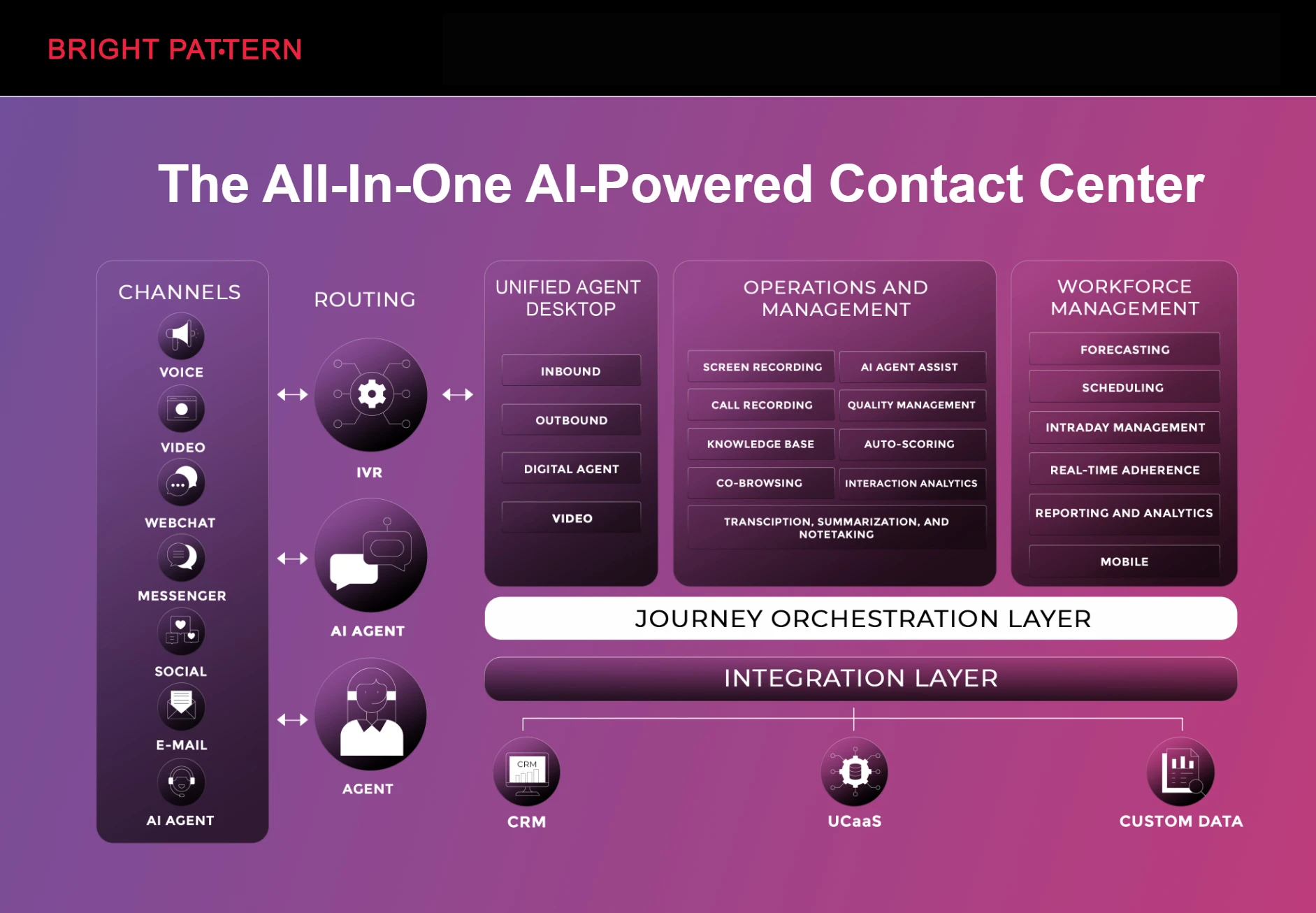
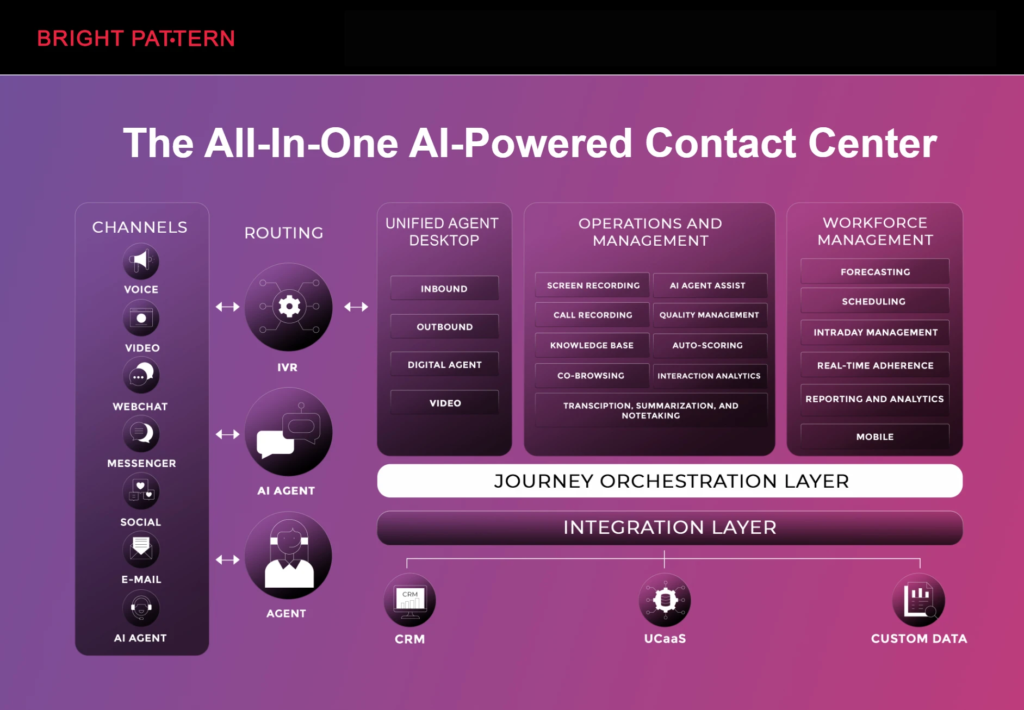
Bright Pattern stands out as a pioneer in the AI contact center space. Its platform goes beyond basic automation by providing a fully integrated omnichannel experience, allowing businesses to manage voice, chat, email, SMS, and social interactions from a single interface. The platform includes real-time agent assistance, which uses AI to suggest responses, knowledge articles, and next-best actions during live interactions.
One of Bright Pattern’s key strengths is its ability to improve First Call Resolution (FCR). By combining AI-driven routing, predictive analytics, and conversational AI, customers can reach the right agent quickly, and agents can resolve issues efficiently. Additionally, Bright Pattern’s platform supports automation tools for routine tasks, such as handling FAQs, ticket creation, and post-call logging, which frees up agents to focus on more complex interactions.
Organizations using Bright Pattern report increased agent productivity, reduced operational costs, and higher customer satisfaction—showing how a thoughtfully designed AI platform can deliver tangible business outcomes.
2. Five9
A consistent leader in AI-powered CCaaS, offering virtual agents, workflow automation, and workforce optimization in one platform. Recognized for its full-stack AI capabilities and enterprise scalability.
3. NICE (CXone)
An enterprise-grade AI contact center platform with advanced analytics, automation, and industry-specific AI solutions. Strong in large-scale deployments and compliance-heavy industries.
4. Genesys
A major CX platform provider offering AI-driven customer journey orchestration, predictive routing, and conversational AI across channels. Widely adopted by global enterprises.
5. Verint
Specializes in AI-powered workforce engagement, speech analytics, and automation tools that enhance both agent productivity and customer experience.
Why these companies matter
AI is transforming call centers into proactive, predictive, and fully automated customer engagement hubs, with capabilities like real-time agent assistance, sentiment analysis, and autonomous resolution becoming standard.
Automating Routine Inquiries with Conversational AI
One of the most immediate ways AI call center solutions reduce costs is by handling repetitive tasks that would otherwise occupy human agents.
Deflecting Low-Value Calls
Every call center handles a large volume of routine questions: password resets, order tracking, FAQs, or account updates. AI chatbots and voicebots can manage these requests efficiently, reducing the number of calls agents must handle.
For example, a mid-sized e-commerce company could divert up to 30–40% of routine inquiries to AI chatbots. This means fewer human resources spent on simple questions and more focus on complex customer issues, ultimately improving both efficiency and satisfaction.
24/7 Availability Without Overtime
Unlike human agents, AI never takes a break. AI chatbots and virtual assistants provide support around the clock, covering nights, weekends, and holidays without incurring overtime costs. Businesses no longer need to pay for night shifts or temporary staffing, yet customers still receive consistent, timely service.
Reducing Cost-Per-Interaction
The financial benefits of automating routine interactions are significant. Every call or chat handled by AI costs far less than one handled by a live agent, especially when scaled across thousands of daily interactions. Over time, these cost reductions can have a dramatic impact on overall operational budgets without compromising service quality.
Enhancing Agent Productivity with Real-Time Assistance
AI solutions don’t just replace repetitive tasks—they empower human agents to perform better and faster.
AI-Powered Agent Assist
Modern AI call center solutions use “whisper” technology to provide real-time guidance to agents. During live calls, agents receive instant prompts from knowledge bases, suggested responses, or troubleshooting steps. This allows them to resolve inquiries faster and more accurately while maintaining a friendly, conversational tone.
For instance, a customer service agent handling technical support calls can receive step-by-step instructions from AI while speaking with a customer, reducing errors and improving first-call resolution rates.
Automated Post-Call Processing
After a call ends, AI can summarize the conversation, update CRM records, and log follow-up tasks automatically. Traditionally, agents would spend several minutes updating records after every call—time that could otherwise be spent helping more customers. By automating these tasks, businesses reduce administrative workload and improve efficiency.
Shortening Average Handle Time (AHT)
With AI assistance, agents can reach solutions faster without rushing customers. Real-time prompts and predictive insights keep calls on track, helping agents resolve issues efficiently while maintaining a high-quality experience. Over thousands of interactions, even small reductions in handle time can translate into substantial cost savings.
Predictive Analytics for Smarter Workforce Management
Beyond individual interactions, AI helps call centers optimize workforce planning and reduce unnecessary costs.
Smarter Staffing Forecasts
AI analyzes historical call data to anticipate busy periods, seasonal spikes, and daily trends. Managers can schedule agents more accurately, avoiding both overstaffing and understaffing. Accurate forecasts prevent wasted labor hours and ensure that service levels remain high, even during unexpected call volume surges.
Reducing Employee Turnover
High employee turnover is expensive due to recruiting, training, and lost productivity. AI can detect early signs of agent burnout, such as sudden changes in call handling time or stress levels. Managers can intervene proactively with support, reducing turnover and the costs associated with replacing staff.
Data-Driven Scheduling
AI can match agents’ skills to incoming call types, ensuring the right agent handles the right interaction. A new agent might focus on routine tasks, while experienced agents tackle complex issues. This improves efficiency, reduces escalations, and maximizes the performance of every team member.
Streamlining Quality Assurance with AI Monitoring
Maintaining quality has traditionally required significant time and resources. AI makes this more efficient and cost-effective.
100% Interaction Coverage
Traditional QA processes review only a small percentage of calls—often 2–5%—leaving potential issues unnoticed. AI can monitor and analyze every interaction, ensuring no customer feedback or issue goes unchecked. This provides a more complete picture of performance and helps managers take informed actions.
Sentiment Analysis and Compliance
AI can detect customer sentiment in real-time and flag calls with negative interactions or potential compliance issues. Managers can address these immediately, reducing risks and maintaining high service standards.
Objective Performance Metrics
AI delivers unbiased, data-driven performance evaluations. Agents are assessed based on real interactions rather than subjective impressions, improving training accuracy and agent morale. This transparency also helps reduce disputes over performance reviews.
Faster Onboarding and Targeted Continuous Training
AI doesn’t just improve daily operations—it accelerates agent development.
AI Roleplay Training
Generative AI can simulate challenging customer scenarios, giving new hires realistic practice before handling live calls. Agents gain confidence and problem-solving experience, reducing mistakes once they are live on the floor.
Pinpointing Skill Gaps
AI continuously analyzes agent performance and identifies areas where improvement is needed. Micro-learning modules can then be delivered directly to the agent, making training targeted, efficient, and relevant.
Lowering the “Time-to-Proficiency”
With AI-assisted roleplay and skill-targeted learning, new agents reach full productivity in days instead of weeks. Faster onboarding reduces training costs and ensures staffing levels remain adequate, even during growth periods.
Conclusion: Scaling Your Customer Service with Intelligence
The long-term ROI of AI call center solutions goes far beyond simple cost savings. By automating routine inquiries, supporting agents in real-time, optimizing workforce planning, streamlining QA, and accelerating training, businesses can do more with less while maintaining exceptional service quality.
Crucially, an AI-first approach does not replace humans. The most effective call centers use AI to handle repetitive tasks while human agents focus on interactions requiring empathy, creativity, and judgment. By finding this hybrid sweet spot, organizations maximize efficiency, improve customer satisfaction, and position themselves for long-term success.
With the right AI call center solutions, businesses can scale intelligently, reduce costs, and provide the high-quality customer experience that today’s market demands.