
Oil clawed back above $97 a barrel Thursday as investors bet the US-Iran ceasefire will not last, and the near-shut Strait of Hormuz is doing little to convince them otherwise. European markets opened lower amid lingering uncertainty over the fragile two-week truce, with investors cautious about the broader Middle East conflict.
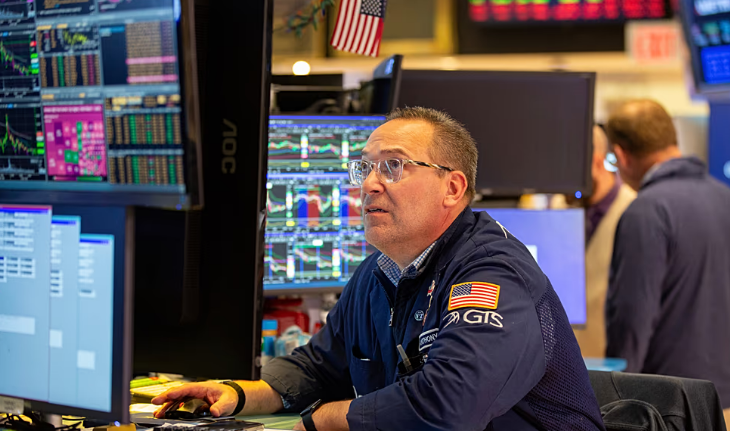
Germany’s DAX fell 0.3%, led by a 1.2% drop in Siemens Energy. The FTSE 100 slipped 0.2%, while the Euro Stoxx 50 and France’s CAC 40 each lost roughly 0.3%, with LVMH down 2% on both indexes by 9:03 a.m. CET.
Oil prices rebounded sharply after an initial plunge following the ceasefire announcement on Tuesday. Brent crude rose 2.4% to $97.02 per barrel, while US West Texas Intermediate gained 3.3% to $97.50, recovering from a brief dip below $92.
The Strait of Hormuz, through which about a fifth of global oil flows, remains largely closed despite repeated US calls to reopen it. The waterway’s restricted passage continues to weigh on markets and highlights doubts that the ceasefire is fully effective. Israeli strikes on Lebanon that killed and injured hundreds of people have added to investor anxiety, reinforcing fears that the regional conflict may not be easing.
In Asia, markets reflected similar caution. Tokyo’s Nikkei 225 dropped 0.9%, South Korea’s Kospi lost 1.6%, and the Shanghai Composite slipped 0.7%. Hong Kong’s Hang Seng fell 0.4%, while Australia’s S&P/ASX 200 and Taiwan’s Taiex each edged 0.1% lower. US futures were marginally down.
The tone contrasts with Wednesday’s rally on Wall Street, where investors initially responded to the ceasefire with optimism. The S&P 500 surged 2.5%, the Dow Jones Industrial Average gained 2.9%, and the Nasdaq rose 2.8%. Travel and airline stocks led the rebound: United Airlines jumped 7.9%, American Airlines climbed 5.6%, and Carnival cruise operator rose 11.2%, partly recovering losses caused by higher fuel costs from the Iran conflict.
Talks aimed at achieving a permanent end to hostilities could start as early as Friday in Pakistan, led by US Vice President J.D. Vance. Analysts warn that the ceasefire’s survival is uncertain, given the continued blockage of the Strait of Hormuz and ongoing Israeli strikes.
Precious metals saw declines as some safe-haven demand eased. Gold fell 0.7% to $4,743.20 an ounce, while silver dropped 1.6% to $74.18. The dollar edged up to 158.66 yen from 158.57, and the euro rose slightly to $1.1668.
With regional tensions unresolved and the crucial oil corridor still restricted, investors remain wary that the US-Iran truce may provide only a temporary pause in volatility for global markets.