Global markets opened the week under pressure as oil prices surged past $100 a barrel and stock markets slipped, following reports that the United States may move to block the Strait of Hormuz.
The spike in energy prices came after Donald Trump announced plans for a potential blockade targeting Iranian-linked shipping, after talks between Washington and Tehran failed to produce a breakthrough. The move has raised fears of further disruption to global energy supplies, as the strait is a key route for a significant share of the world’s oil.
Benchmark crude prices reacted sharply. Brent crude rose about 7% to nearly $102 a barrel in early European trading, while US West Texas Intermediate climbed close to $104. The gains extend a rally that began earlier in the conflict, with prices having jumped from around $70 per barrel before hostilities escalated.
Analysts say the latest developments have shifted investor sentiment. A note from Deutsche Bank described a clear “risk-off” mood, with concerns growing about a potential stagflationary shock as higher energy costs weigh on growth while keeping inflation elevated.
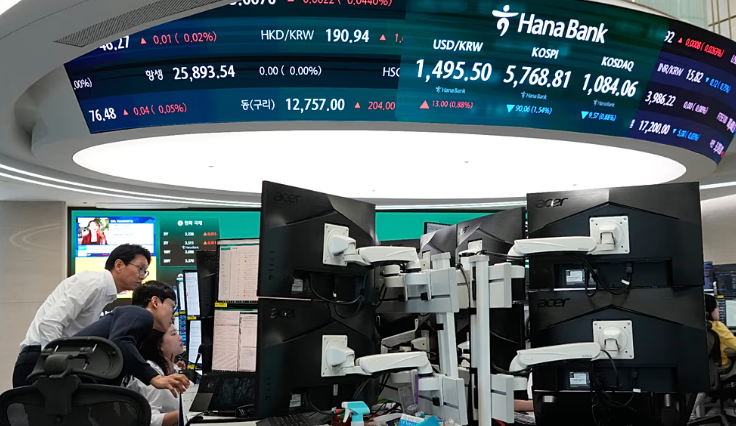
Equity markets reflected that caution. Major European indices opened lower, with London’s FTSE 100 down 0.4%, Frankfurt’s DAX falling 1%, and Paris’s CAC 40 slipping nearly 0.9%. Asian markets also declined, with Japan’s Nikkei 225, South Korea’s Kospi and Hong Kong’s Hang Seng all posting losses during Monday trading.
Currency markets saw mixed movements. The euro weakened against the US dollar, while the British pound also slipped slightly. In contrast, Hungary’s currency moved in the opposite direction after a significant political development.
The Hungarian forint strengthened following a decisive election victory for Péter Magyar and his Tisza Party, ending the long rule of Viktor Orbán and his Fidesz party. The euro dropped to 366.18 forints, marking a sharp gain for the local currency. Hungary’s main stock index also rose nearly 3%, standing out against the broader market downturn.
Investors appear to be betting that a new government could steer Hungary toward closer alignment with the European Union, potentially improving investor confidence and economic cooperation.
Market attention is now turning to a packed week of economic data and corporate earnings. Major US banks and technology firms, including JPMorgan Chase and Goldman Sachs, are set to report results, offering insight into how businesses are coping with rising geopolitical risks.
At the same time, fresh US inflation data and jobless claims figures are expected to influence expectations around interest rate decisions by the Federal Reserve. The International Monetary Fund will also release its latest global economic outlook during its spring meetings in Washington.
With tensions in the Middle East unresolved and energy markets on edge, analysts warn that volatility is likely to persist in the days ahead.