

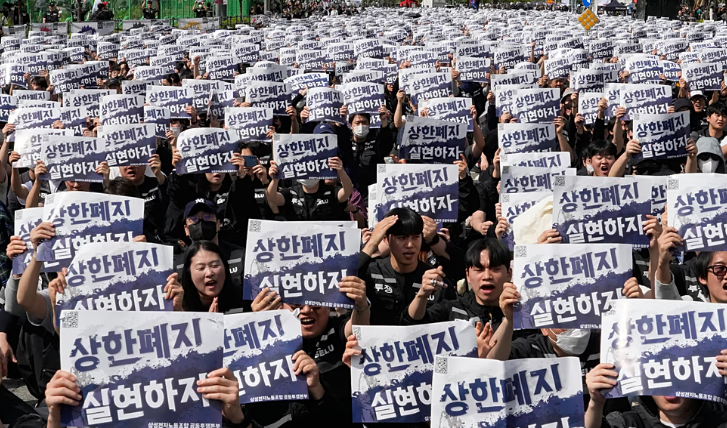
Thousands of workers at Samsung Electronics gathered on Thursday at a major semiconductor complex in Pyeongtaek, South Korea, escalating tensions with management over bonus payments despite the company reporting record earnings driven by the global artificial intelligence boom.
Union members, many holding banners and chanting slogans calling for greater transparency in compensation, demanded the removal of limits on performance bonuses and a restructuring of the company’s reward system. Organisers said about 40,000 workers joined the demonstration, although police did not confirm an official figure. The rally took place under a strong police presence at one of Samsung’s key chip production sites.
The dispute comes as Samsung’s semiconductor division continues to benefit from soaring global demand for memory chips used in AI data centres. Earlier this month, the company projected a record operating profit of 57.2 trillion won (€33 billion) for the first quarter, fuelled by the surge in AI-related infrastructure investment.
Despite the strong financial results, Samsung’s labour union, which represents roughly 74,000 employees, says workers have not received fair compensation. The union has rejected the company’s proposal to award bonuses in restricted stock and is calling for the elimination of bonus caps, arguing that current policies do not reflect the scale of the company’s profits.
Union leader Choi Seung-ho addressed protesters from a raised platform at the site, declaring that workers would continue pressure on management until their demands were met.
If negotiations fail, the union has warned it could launch an 18-day strike beginning May 21, a move it claims could cost Samsung more than 1 trillion won (€578 million) per day in lost production.
The protest coincided with strong results from rival chipmaker SK Hynix, which reported its highest-ever quarterly revenue and operating profit, citing unprecedented demand from the artificial intelligence sector. Together, Samsung and SK Hynix account for around two-thirds of global memory chip production.
While the semiconductor industry has been boosted by AI-driven demand, external risks are emerging. Disruptions linked to conflict in the Middle East have raised concerns about supply chains for materials such as helium and increased energy costs used in chip fabrication.
However, SK Hynix executives said during a Thursday earnings call that while they are monitoring geopolitical risks closely, they do not expect immediate disruptions to production.
As negotiations continue, the dispute highlights growing friction between record corporate profits and worker compensation in one of South Korea’s most important export industries.