

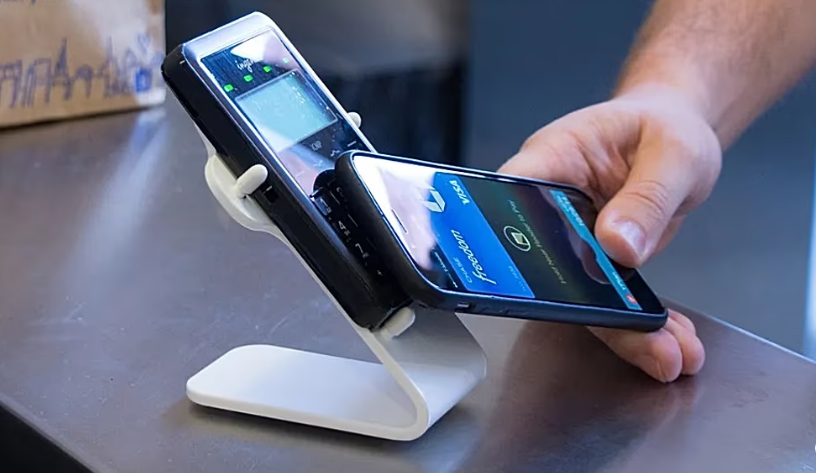
Mobile payments are becoming a larger part of everyday life across Europe as consumers turn to smartphones and other smart devices for quicker, more convenient transactions. New figures from the European Central Bank (ECB) show a steady rise in digital wallet use, though adoption rates still vary widely across the continent.
According to the ECB, mobile payments accounted for 6% of all point-of-sale (POS) transactions in the euro area in 2024, representing 7% of the total value. In 2019, mobile payments made up just 1% of both categories, reflecting rapid growth in just five years. These payments include purchases made using smartphones, smartwatches, fitness bands, and other connected devices.
Even as digital options expand, traditional payment methods remain prominent. The ECB’s SPACE survey found that 75% of daily transactions across the euro area in 2024 still occurred at physical POS terminals. Online payments made up 21%, while person-to-person transfers accounted for 4%. In terms of payment value, POS transactions represented 58%, online payments 36%, and P2P transfers 6%.
Cash remains the most frequently used payment method, making up 52% of all transactions but just 39% of total value, suggesting it is primarily used for smaller purchases. Cards accounted for 39% of transactions and 45% of value. Mobile payments, while growing, still represent a small share at 6% of transactions and 7% of value.
The Netherlands continues to set the pace for digital payment adoption. Mobile devices are used in 19% of all POS transactions there — the highest share in the euro area. The Dutch Central Bank attributes this to widespread comfort with contactless technology and the view that digital payments offer greater speed and convenience. Ireland and Finland also report strong uptake, with mobile payments making up around 10% of their POS transactions.
At the other end of the spectrum, Slovenia, Croatia, and Belgium report the lowest mobile payment shares, each at just 3%. Among Europe’s largest economies, Spain stands out with a 7% share, exceeding the euro-area average. Germany aligns with the overall rate at 6%, while France and Italy remain below it. In terms of payment value, the Netherlands again leads with 17%, followed by Spain at 12%.
While consumers embracing mobile payments cite convenience as a key motivator, the ECB notes that hesitation persists among those who prefer more traditional methods. Concerns about security remain a major barrier, with 28% of non-users citing fears of hacking and 27% expressing worry about fraud risks.
As digital tools continue to reshape consumer behaviour, the data indicates that mobile payments are steadily gaining ground — though the shift is unfolding at different speeds across Europe.