


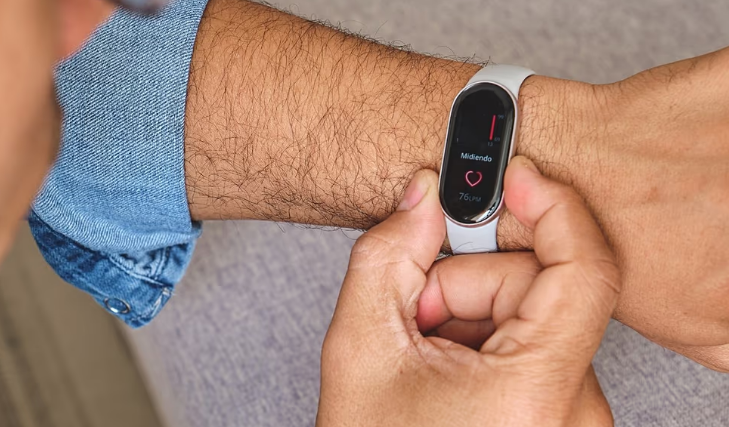
New research suggests that sensors integrated into loose clothing may track body movements more accurately than traditional tight-fitting wearables. “Sensors in looser clothing outperform tight wearables in tracking body metrics, according to new research,” the study found.
The research, published in Nature Communications, showed that loose fabrics could predict and capture movement with 40 percent more accuracy while using 80 percent less data than conventional wearables. Traditional fitness trackers, typically strapped tightly around the wrist or body, measure raw movement and vital signs before converting them into metrics such as steps, calories, or sleep stages.
The study challenges the long-held assumption that loose sensors produce “noisy” or unreliable data. Matthew Howard, co-author of the paper and reader in engineering at King’s College London, explained that flowing fabric reacts more sensitively to movement than tight straps. “Meaning, we could move away from ‘wearable tech’ that feels like medical equipment and toward ‘smart clothing’ — like a simple button or pin on a dress — that tracks your health while you feel completely natural going about your day,” Howard said. He added that when someone moves their arm, a loose sleeve folds and shifts in ways that provide more precise tracking than a tight-fitting sensor.
The team at King’s College tested sensors on various fabrics, using both human and robotic subjects performing a range of movements. Comparisons with standard motion sensors showed that loose fabric sensors detected movement faster, more accurately, and with less data. Researchers also found that the sensor’s placement within the garment or its distance from the body did not affect accuracy.
Loose clothing sensors could be particularly useful for monitoring subtle movements that current wearables often miss, such as tremors associated with Parkinson’s disease. “Through this approach, we could ‘amplify’ people’s movement, which will help capture them even when they are smaller than typical abled-bodied movements,” said Irene Di Giulio, co-author of the study at King’s College. She added that the technology could enable monitoring in everyday settings, including homes and care facilities, by attaching sensors to buttons or small areas of clothing.
This approach could make it easier for doctors to track patients remotely and allow medical researchers to gather vital data to improve treatments and wearable technologies for people with disabilities.
Current wearable devices, while effective at tracking steps and basic movement, have limitations in clinical measurements such as heart rate variability, blood pressure, and oxygen levels. Studies have found that devices like the Apple Watch are accurate at monitoring heartbeats at rest but can produce inconsistent readings during activity or when estimating energy expenditure.
The findings open the door for a new generation of “smart clothing” that blends health tracking seamlessly into daily life, offering improved accuracy, comfort, and the potential to assist in clinical monitoring in ways traditional wearables cannot.