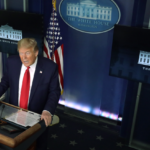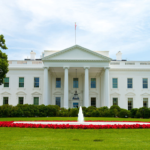


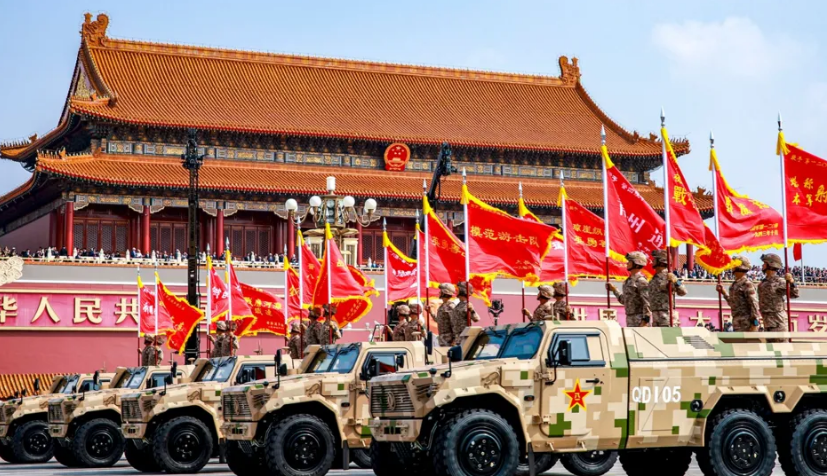
The People’s Republic of China staged a vast military parade in Beijing on Wednesday to mark the 80th anniversary of the end of World War Two, showcasing its growing arsenal and global ambitions. The event, held in Tiananmen Square, was watched closely around the world — including at the White House, where US President Donald Trump acknowledged the spectacle.
“They were hoping I was watching, and I was watching,” Trump remarked during a meeting with Polish President Karol Nawrocki. While describing the event as “very, very impressive,” he offered little further insight. The display, attended by Russian President Vladimir Putin, North Korean leader Kim Jong Un and more than two dozen other heads of state, was widely interpreted as a signal that China intends to assert itself as a counterweight to US dominance.
Trump’s response shifted throughout the week. In a podcast on Tuesday, he downplayed the parade, insisting he was “not concerned” about China’s show of force. Hours later, however, he complained on his Truth Social platform that Beijing had failed to credit the United States for its decisive role in World War Two. “Please give my warmest regards to Vladimir Putin and Kim Jong Un, as you conspire against the United States of America,” he wrote.
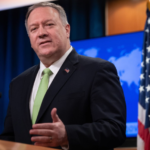
China’s parade combined cutting-edge weaponry with historical symbolism, presenting the Communist Party as a central force in defeating fascism and imperialism in Asia. Analysts said the narrative seeks to lay the groundwork for what Beijing hopes will be a new global order. “It’s the first step in a concerted effort to rewrite the rules of the road,” said Richard Wilkie, a former Trump administration official, arguing that the communist role in Japan’s defeat was being overstated.
The military display came amid a broader geopolitical realignment. Earlier in the week, President Xi Jinping met with Putin and Indian Prime Minister Narendra Modi at an economic summit in Tianjin, a meeting seen as evidence of closer ties between Beijing and New Delhi. Observers linked the thaw to Trump’s tariff policies, which have strained US trade relations with both China and India.
Trump has embraced tariffs as central to his “America First” economic strategy, insisting they protect US industry and generate federal revenue. But critics warn the measures may be backfiring, pushing rivals together while facing mounting legal challenges at home. A US appellate court recently ruled many of the tariffs unlawful, and the case is now expected to head to the Supreme Court.
While Trump continues to champion military parades and a nostalgic vision of US power, Beijing’s display of modern weaponry highlighted a future where China plays a far more assertive role. The question now is whether Trump’s trade and foreign policy gambles will strengthen America’s position — or accelerate the shift in global influence on display in Tiananmen Square.