

As the war between Iran, the United States, and Israel intensifies, European cities are increasingly within range of Tehran’s long-range missiles and drones. The conflict, which began after US and Israeli strikes killed Ayatollah Ali Khamenei and significantly damaged Iran’s military and security forces, has prompted Tehran to launch a campaign of missile and drone attacks across the region.
Iranian projectiles have struck targets in Israel and Gulf states, while an Iranian-made drone targeted a British base in Cyprus. This prompted the UK to open bases for US defensive counter-strikes against Iranian missile sites. NATO systems intercepted two ballistic missiles aimed at Turkish airspace, marking a threshold Tehran had not crossed before.
Iran’s long-range arsenal includes three main weapons capable of reaching Europe. The Khorramshahr ballistic missile, with a warhead up to 1,800 kg, can hit cities from Athens and Sofia to Vienna, Rome, and Berlin depending on payload. Shahed-136 drones, battle-tested in Ukraine, can travel up to 2,500 km and are designed to overwhelm air defences in swarms. Cruise missiles such as the Soumar, with ranges of 2,000–3,000 km, fly low to evade radar, making them ideal for targeted strikes on infrastructure.
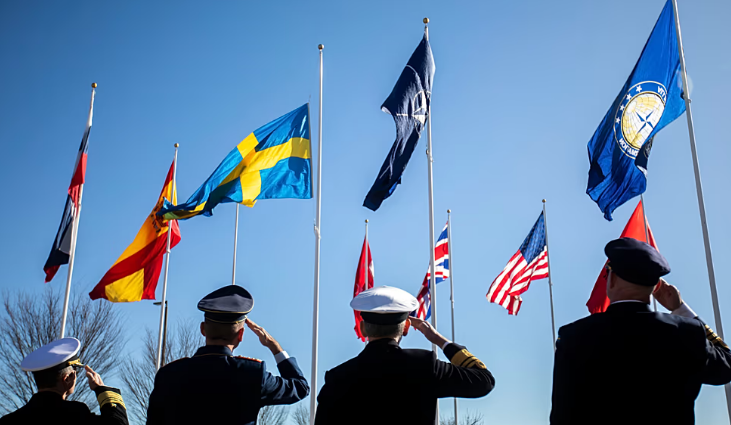
NATO’s experience in Israel provides a reference for missile defence. During the war, Israel faced over 500 Iranian ballistic missiles, most of which were intercepted. NATO spokesperson Colonel Martin L. O’Donnell emphasized that Europe is protected by a multilayered system combining land, sea, and space-based detection and interception. Recent missile intercepts in Turkey demonstrated the alliance’s readiness, with detection-to-destruction times under 10 minutes.
Non-NATO European states, such as Cyprus, Austria, and Switzerland, are not formally covered, though initiatives like the European Sky Shield integrate some neutral countries into continental air defence. European countries have also taken independent steps; recent Iranian strikes prompted rapid deployment of frigates and fighter jets to defend Cyprus.
Experts warn that Iran’s tactics could go beyond conventional missile strikes. Graig R. Klein, a political violence expert at Leiden University, noted that Iran could use state-linked networks or proxies to target dissidents, journalists, and Jewish communities in Europe. Cyberattacks on energy, water, and healthcare infrastructure are also likely, alongside potential maritime sabotage.
While the Iranian regime possesses technical capabilities for more extreme measures, including nuclear or dirty bombs, experts believe such options are unlikely due to high political risk. Analysts expect Iran to focus on targeted disruption, psychological pressure, and hybrid attacks aimed at destabilising European governments and societies rather than large-scale civilian casualties.
The war’s escalation has placed Europe closer than ever to the frontlines. NATO stresses that its defence systems are operational and capable, yet hybrid threats from drones, cyber operations, and proxies remain a challenge, highlighting the evolving complexity of modern warfare on European soil.