


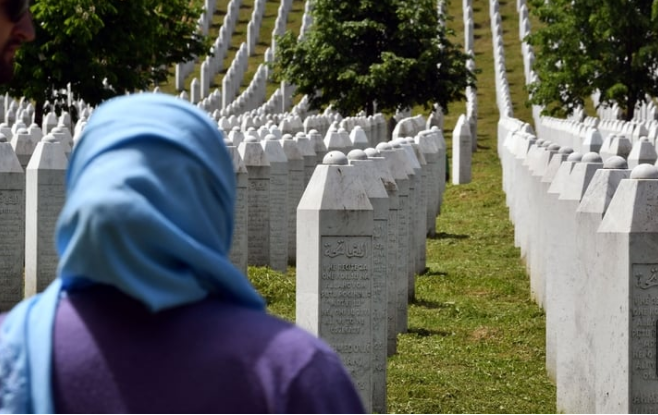
Nearly three decades after the fall of Srebrenica, Hajrudin Mesić still carries the trauma of being one of the few survivors of the 1995 genocide—an atrocity that claimed the lives of over 8,000 Bosnian Muslim men and boys.
Now a teacher in Sarajevo, Mesić was just 21 years old when Bosnian Serb forces overran the United Nations-declared “safe area” of Srebrenica in July 1995. His harrowing escape through the forests of eastern Bosnia is a chilling reminder of the scale and brutality of the killings carried out under the command of General Ratko Mladić.
“We didn’t come here to negotiate—we came to end things once and for all,” Mesić recalled a militia fighter saying before killing a fellow Bosniak who had surrendered. That moment, he said, revealed the full genocidal intent of the Bosnian Serb forces. “I realised they would kill everyone. I decided it was better to die trying to live.”
Over 17 days, Mesić evaded capture, surviving starvation, exhaustion, and ambushes. Along the way, he lost three of his brothers—killed by sniper fire, artillery shells, or during the death marches through the woods. A fourth brother’s remains were found in a minefield years later.
When he finally reached safety, his parents welcomed him like a “gift from heaven.” But the psychological scars ran deep. “Srebrenica is my open wound that will never heal,” he said.
The genocide unfolded after Bosnian Serb forces, supported covertly by Serbia’s then-president Slobodan Milošević, captured the enclave despite its UN “safe area” status. Mladić’s forces lured men from hiding with false promises of safety and then systematically executed them, while women and children were bussed away.
Mladić, who was filmed in Srebrenica referring to Bosnian Muslims as “Turks” in a chilling call for revenge, was convicted of genocide and war crimes in 2017 by the International Criminal Tribunal for the former Yugoslavia.
Mesić said the international community’s inaction during the massacre felt like betrayal. “They said ‘never again’, but today, that promise is broken time and again—in Gaza, Sudan, and elsewhere,” he said.
Last year, the UN General Assembly adopted a resolution declaring July 11 as the International Day of Reflection and Commemoration of the 1995 Genocide in Srebrenica, condemning denial and glorification of war criminals. Yet Mesić points to the continuing denial of genocide by Bosnian Serb leaders as evidence that justice remains incomplete.
Despite the pain, Mesić urges remembrance and resilience. “Giving up is not an option,” he said. “As survivors, we must tell our stories. That is our duty to the truth—and to those who never made it.”