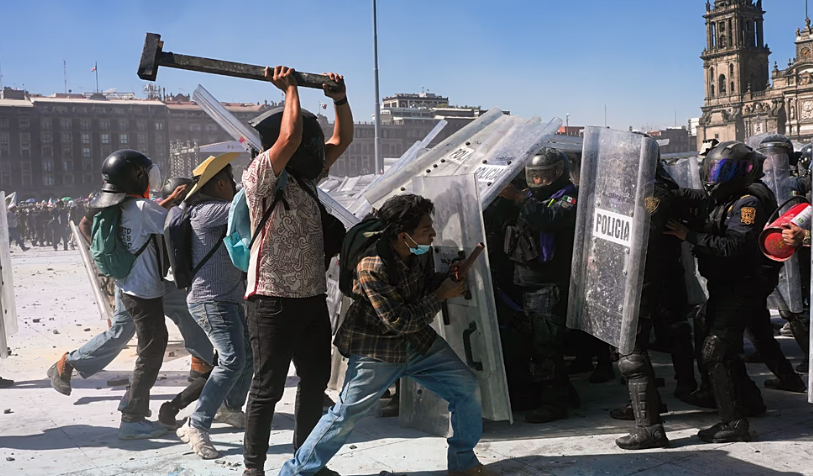
Thousands of young people marched through Mexico City on Saturday in a nationwide protest against violence and corruption, culminating in violent clashes at the Zócalo that left 20 civilians and over 100 police officers injured. Authorities arrested roughly 20 individuals during the unrest.
The demonstration, organized by a civic group identifying as Generation Z, included simultaneous marches in 52 cities across Mexico and in countries including the United States, Canada, the Netherlands, and Germany. The movement gained momentum after the murder of Uruapan’s mayor, Carlos Manzo, on 1 November. Manzo had repeatedly urged the federal government to address organized crime in Michoacán, but his calls went unheeded. His killing sparked nationwide indignation among young people frustrated with what they see as a corrupt and unresponsive political system.
The march began peacefully at the Angel of Independence, with participants including students, villagers, opposition party members, and other citizens concerned about the rising crime. The mood turned chaotic upon reaching the Zócalo. A group identified as the “black bloc” broke away from the main march, smashing fences around the National Palace with hammers and stones. Police responded with tear gas and fire extinguishers. Of the injured officers, 60 were treated at the scene while 40 were hospitalized, four requiring specialized care. All injured civilians were treated at the site. Arrested individuals faced charges of “violent acts,” and 20 others were processed for administrative offenses. Authorities are working to identify all those responsible for criminal acts during the protest.
President Claudia Sheinbaum called for protests to remain peaceful, stating from Tabasco, “Violence must never be used for change; always peacefully.” She described the turnout as “very few young people,” despite reports of thousands participating in the demonstration.
Generation Z positions itself as a non-partisan civic movement. Ahead of the marches, the group published a 12-point petition under the slogan “Because we are not for any party. We are for Mexico.” The demands include mechanisms for citizen recalls separate from regular elections, reforms to strengthen judicial and autonomous institutions, audits to combat corruption, improved public security, access to education, jobs and housing, and the inclusion of figures with moral authority in citizens’ councils.
The movement is part of a global trend of youth-led protests in countries such as Nepal, Mongolia, Togo, Madagascar, Morocco, Paraguay, Peru, Bangladesh, and Indonesia. Young organizers rely heavily on social media platforms like TikTok, Instagram, and X to mobilize participants, bypassing traditional media channels. In Mexico, Generation Z is calling for a fundamental shift in governance, driven by frustration over corruption, economic challenges, and limited opportunities.
The demonstrations highlight the growing role of youth activism in shaping political discourse, with participants demanding accountability, transparency, and tangible reforms in a country long challenged by crime and systemic corruption.