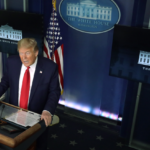


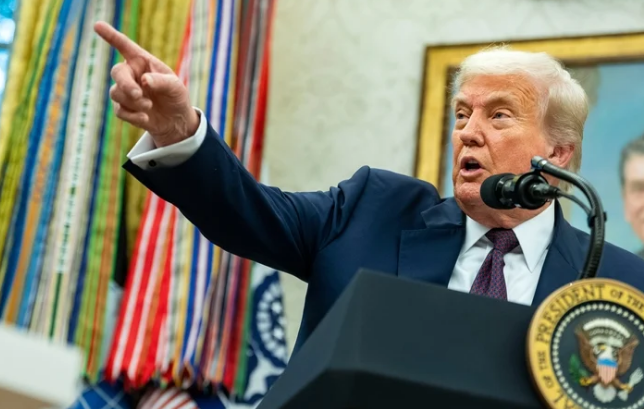
U.S. President Donald Trump appears to be gaining ground in the trade war he reignited upon returning to office in January, using sweeping tariff measures to pressure trading partners, curb imports, and reduce the trade deficit. However, economists and legal experts warn that the long-term economic and legal viability of his strategy remains uncertain.
Since his second inauguration, the effective U.S. tariff rate has surged from 2.5% to an estimated 17–19%, with the Atlantic Council predicting it could soon reach 20%—the highest in a century. Despite the dramatic hikes, retaliatory tariffs from trading partners have been limited, preventing a broader global trade conflict for now.
U.S. trade data released Tuesday showed a 16% narrowing of the trade deficit in June, while the trade gap with China hit its lowest level in over two decades. But alongside these gains, concerns are rising about inflation, economic growth, and job losses.
“Trump is raising tariffs on the rest of the world and avoiding a retaliatory trade war more easily than even he anticipated,” said Josh Lipsky, director of economic studies at the Atlantic Council. “But the bigger question is what effect that has on the U.S. economy.”
Michael Strain, a senior economist at the American Enterprise Institute, warned the administration’s aggressive strategy could backfire. “Trump may be securing foreign concessions, but at the cost of inflicting more economic pain on Americans than other nations are inflicting on their own populations. That’s not winning—it’s losing,” he said.
The Trump administration has so far concluded eight trade agreements—with the EU, UK, Japan, South Korea, Vietnam, Indonesia, Pakistan, and the Philippines—introducing new tariffs of 10–20%. These deals cover about 40% of U.S. trade, and inclusion of China would bring that to nearly 54%.
Yet the ad-hoc nature of Trump’s tariff decisions has drawn criticism. India, Brazil, and Switzerland have all faced sudden tariff hikes in recent weeks, often linked to unrelated political disagreements or geopolitical concerns.
Kelly Ann Shaw, a former White House trade adviser, noted the strategy is bold but untested. “Trump is the first president in decades to fundamentally reshape the global trading system. But history will judge whether these changes stick,” she said.
Legal challenges could also unravel parts of the policy. Trump’s use of the 1977 International Emergency Economic Powers Act as the basis for many tariffs is now under judicial review, with a ruling expected soon—and potential Supreme Court involvement likely.
As the administration pushes ahead, enforcement mechanisms for the billions in investment pledges remain unclear. Critics say the deals lack binding commitments, and point to China’s failure to deliver on prior trade promises as a cautionary tale.
While the strategy may be delivering short-term wins, the road ahead remains complex. The effectiveness—and legality—of Trump’s trade war may not be fully known until long after the dust settles.