

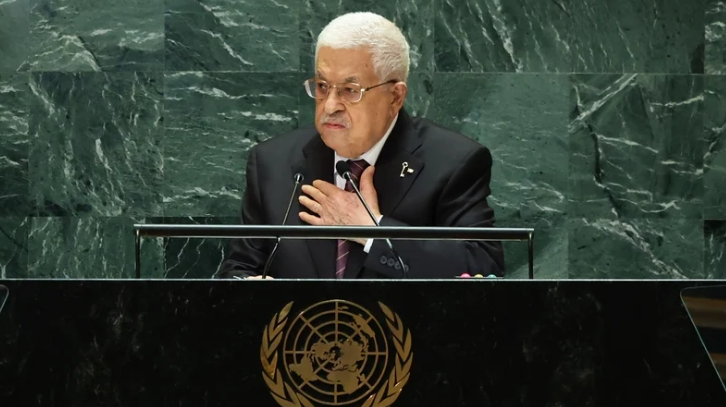
The United States has said it will not allow Palestinian Authority President Mahmoud Abbas to travel to New York next month for the annual United Nations General Assembly, where several Western powers are expected to formally recognise Palestine as a state.
A State Department official confirmed that Mr Abbas and around 80 other Palestinians would be affected by the decision, which involves denying or revoking visas for members of the Palestine Liberation Organization (PLO) and the Palestinian Authority (PA). While the Palestinian mission to the UN, staffed by permanent officials, will not be impacted, the move prevents the Palestinian president from attending the high-level gathering of world leaders.
Mr Abbas had also planned to participate in a separate summit hosted by France and Saudi Arabia in New York, at which Britain, France, Australia and Canada have pledged to recognise Palestinian statehood. His office said it was “astonished” by Washington’s decision, describing it as a violation of the 1947 UN Headquarters Agreement, which generally obliges the US to grant access to foreign diplomats attending UN sessions.
Washington argued that the decision was justified on national security and foreign policy grounds. “It is in our national security interests to hold the PLO and PA accountable for not complying with their commitments, and for undermining the prospects for peace,” the State Department said. It cited longstanding allegations that the Palestinian leadership had failed to repudiate extremism and continued to seek “unilateral recognition” of statehood.
Palestinian officials rejected these claims, countering that decades of US-led negotiations have failed to deliver an end to Israeli occupation or progress towards a two-state solution. They noted that in June Mr Abbas had condemned the October 2023 Hamas attack on Israel in a letter to French President Emmanuel Macron and had called for the release of hostages.
The US stance has drawn criticism from European allies. French Foreign Minister Jean-Noel Barrot said there should be “no restrictions” on attendance at the UN General Assembly, a view echoed by other EU officials. UN spokesperson Stephane Dujarric said the organisation would raise the matter with the US in line with the Headquarters Agreement.
The move recalls a similar episode in 1988, when Washington refused to issue a visa to then-PLO leader Yasser Arafat. On that occasion, the UN General Assembly convened in Geneva to allow him to speak.
Israel welcomed the latest US decision. Foreign Minister Gideon Saar praised Washington’s position, as Israel faces growing frustration from allies over its war in Gaza and ongoing settlement expansion in the West Bank.
Currently, 147 of the UN’s 193 member states recognise Palestine as a state. The Palestinians hold observer status at the UN, similar to the Vatican, and continue to press for full recognition with East Jerusalem as the capital of a future independent state. The US insists, however, that Palestinian statehood must come only through direct negotiations with Israel.