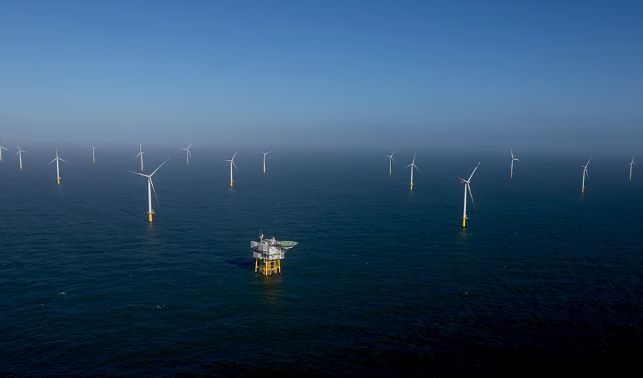
The United States government will pay German energy company RWE $1.22 billion (€1.06 billion) to relinquish several offshore wind leases, marking another major setback for the country’s renewable energy sector under President Donald Trump.
RWE said on Thursday that it had reached an agreement with the US Department of the Interior to give up leases linked to proposed wind projects off the coasts of New York, California and Louisiana.
The company said it had determined that there was no realistic path to obtaining permits for the projects in the foreseeable future.
The settlement comes as the Trump administration continues its efforts to halt or restrict offshore wind development across the United States. Trump has repeatedly criticised wind turbines, describing them as unattractive and an economic and environmental problem.
The president has also said he does not want new wind turbines built during his time in office.
The administration has increasingly favoured conventional energy sources as it seeks to expand domestic power production and meet rising electricity demand.
RWE said it would redirect some of its planned US investment towards gas projects. The company plans to spend $900 million acquiring a 16% stake in a liquefied natural gas project in Louisiana.
The German group said its US operations had broader plans to invest about €17 billion over the next six years. The investment programme is expected to increase its electricity generation capacity in the country from about 13 gigawatts across 27 states to 22 gigawatts by 2031.
The agreement follows a similar deal involving French energy company TotalEnergies. In March, the company agreed to relinquish offshore wind leases in the Carolina Long Bay and New York Bight areas.
The Interior Department said it would pay TotalEnergies about $1 billion under that arrangement, while the company planned to redirect investment towards natural gas projects.
US Interior Secretary Doug Burgum welcomed the RWE settlement, saying the agreement would support energy security and reliable electricity supplies.
The changes come as US electricity demand is expected to rise, driven partly by data centres, manufacturing and other energy-intensive industries. The Trump administration has argued that natural gas and other conventional energy sources can provide dependable power as the country expands its electricity infrastructure.
RWE’s decision highlights the growing uncertainty facing offshore wind developers in the US, where projects have encountered regulatory, political and economic obstacles.
For the company, shifting part of its investment towards gas represents a significant change in strategy as it responds to the changing US energy policy environment.