

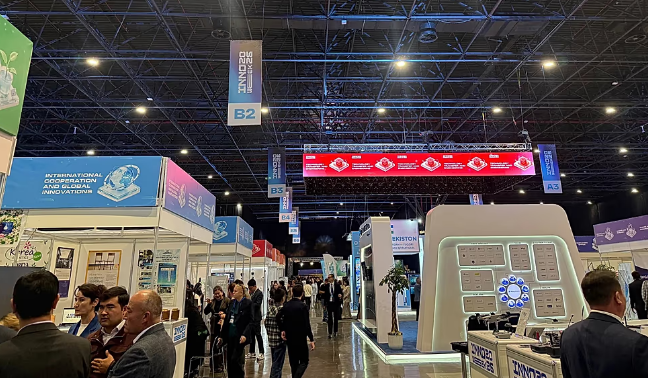
Uzbekistan is seeking to turn domestic research and engineering projects into commercially viable products, with innovators showcasing technologies for firefighting, agriculture, renewable energy and transport at InnoWeek 2026 in Tashkent.
The exhibition brought together researchers, companies and university students presenting inventions aimed at addressing practical challenges, while exploring opportunities for manufacturing and exports.
One of the projects attracting attention was a remotely operated firefighting robot developed in cooperation with Uzbekistan’s Ministry of Emergency Situations. The tracked prototype is designed to approach fires and operate a water cannon, allowing emergency crews to remain at a safer distance.
The robot can be controlled from between 500 and 800 metres away. Its developers say the tracks can withstand temperatures of at least 500°C, while a metal-track version is being designed for temperatures of up to 1,000°C. The team is also exploring artificial intelligence to support automated control of the water cannon.
The project remains at the prototype stage, with a patent application submitted. Qudratjon Yusupov, an economist involved in its development, estimated the production cost at around €8,100, compared with approximately €15,300 for a similar Chinese model.
The developers are considering petrol stations and gas facilities as potential customers and are exploring sales opportunities in neighbouring Kyrgyzstan and Tajikistan.
Agricultural technology was another focus at the exhibition. Uzbek manufacturer Sahro Drone Industry presented a multipurpose unmanned aircraft capable of carrying up to 50 kilograms. By changing its platform and tank, the drone can be adapted for crop spraying and firefighting.
The aircraft can distribute fertilisers and treatments across fields with mature crops, reducing the need for tractors that may damage plants.
Shavkat Quchqorov, a specialist at the company, said around 90 per cent of its production was intended for military applications, with the remaining 10 per cent serving agriculture, emergency response and other civilian uses. The company currently produces 14 types of military drones, with around 70 per cent of their components sourced locally.
Sahro Drone Industry plans to begin exporting drones in 2027. Depending on demand, annual production could reach approximately 100 larger aircraft and up to 60,000 smaller models.
Universities are also working to move student inventions towards commercial production. Students at Kimyo International University in Tashkent developed a tree-shaped energy installation combining solar panels and wind turbines to power outdoor lighting and security cameras. The system includes batteries to store electricity, with an estimated manufacturing cost of $2,000 per unit.
At Turin Polytechnic University in Tashkent, students have built a 250-kilogram electric vehicle designed for energy-efficiency competitions. The Cosmos Innovation team reported energy consumption of 0.6 kilowatt-hours per 10 kilometres and hopes to compete in the 2027 Shell Eco-marathon in the United States.
Turning prototypes into market-ready products remains a challenge. Georg Guggenberger, a professor at Leibniz University Hannover, said researchers, innovators and businesses needed to work more closely to connect scientific development with commercial applications.
Uzbekistan’s Agency for Innovative Development is promoting cooperation through spin-off companies and joint research funding. Deputy director Javlonbek Abdujalilov said 20 spin-off companies were participating in InnoWeek 2026, while new funding arrangements allow businesses and the government to share research costs.