
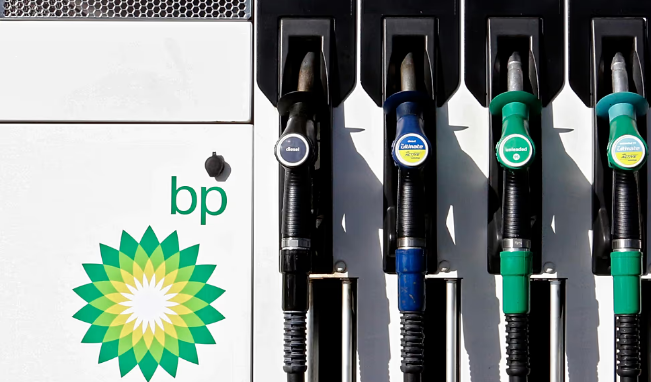
BP reported a sharp increase in third-quarter profits as the conflict involving Iran pushed oil prices and refining margins higher, helping the British energy company exceed market expectations and reduce its net debt by $8.4 billion.
The oil and gas major said on Friday that profit attributable to shareholders reached $4.7 billion for the July to September period, compared with $1.16 billion a year earlier.
Underlying replacement cost profit, a key measure used by investors to assess BP’s performance, nearly quadrupled to $8.5 billion from $2.2 billion. The figure was well above analysts’ expectations of $6.2 billion.
The results were supported by stronger refining and trading earnings as the conflict disrupted fuel exports from the Middle East, tightening global supplies and increasing margins for refineries in other regions.
Chief Executive Meg O’Neill, who took over in April, described the performance as a strong set of results, supported by an environment of higher prices and margins.
BP’s underlying profit measure excludes changes in the value of oil and fuel inventories and certain exceptional items. The company recorded $4 billion in writedowns during the quarter, mostly involving businesses linked to the energy transition.
Debt reduction and shareholder payments
BP reduced net debt to $13.9 billion at the end of September, down from $22.3 billion three months earlier. The $8.4 billion reduction was supported by stronger cash generation and the company’s decision in February to suspend share buybacks, allowing additional funds to be directed towards its balance sheet.
The company said it had achieved its debt and cost-cutting targets. It maintained its quarterly dividend at 8.66 cents per share.
BP also plans to prioritise the use of surplus cash to settle its remaining liabilities arising from the 2010 Deepwater Horizon disaster in the Gulf of Mexico, which killed 11 workers and caused a major oil spill. Last week, the company agreed to accelerate payments under a $16 billion settlement with the US state of Louisiana.
O’Neill is due to present BP’s updated strategy on December 15. The company has already reduced spending on clean energy projects as it shifts its focus towards more profitable oil and gas operations. Rivals Shell and TotalEnergies also reported strong profits on Thursday.
Oil prices remain elevated
Brent crude traded at around $113.60 a barrel on Friday, approximately 2.5 per cent higher for the week. US benchmark West Texas Intermediate stood at about $104.20, up around 1.5 per cent.
Both benchmarks remain well above their pre-war levels, with Brent trading at approximately $72 a barrel before the conflict began in late February.
BP has raised its assumption for the average Brent price in 2026 to $87 a barrel, from $70, using inflation-adjusted 2024 prices. The company expects supply disruptions in the Middle East to continue into 2027 and refining margins to remain elevated during the final quarter of this year.
BP shares rose 0.3 per cent in early trading on Friday.