

Global stock markets moved higher on Wednesday, supported by easing oil prices and renewed optimism that diplomatic talks between Washington and Tehran could help bring an end to the ongoing conflict.
In Europe, trading was mixed but broadly stable. The pan-European Stoxx 600 slipped slightly, while Germany’s DAX edged up 0.11% and London’s FTSE 100 gained a similar margin. France’s CAC 40 declined by 0.65%, reflecting cautious sentiment among investors.
The gains followed a strong session on Wall Street, where major indices rallied after oil prices retreated. The S&P 500 rose 1.2%, moving to within 0.2% of its record high set earlier this year. The Dow Jones Industrial Average climbed 0.7%, while the Nasdaq Composite surged 2%, driven by technology shares.
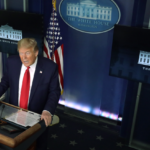
Investor sentiment improved after Donald Trump said fresh talks between the United States and Iran could take place in Islamabad within days. He suggested the conflict was nearing an end, though uncertainty remains over key issues in negotiations.
Asian markets also posted gains. Japan’s Nikkei 225 rose 0.5%, while South Korea’s Kospi jumped 3%. Hong Kong’s Hang Seng Index added 0.7%, and China’s Shanghai Composite edged up 0.2%.
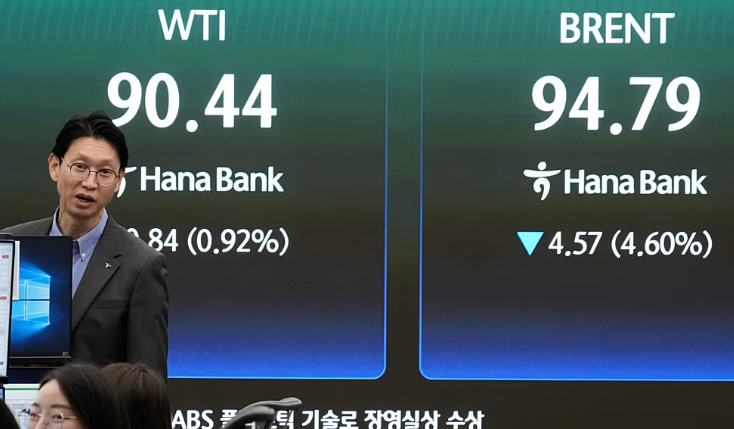
Oil prices remained volatile but generally lower. Brent crude rose slightly to around $95 per barrel after a sharp drop in the previous session, while US crude hovered near $91. Prices remain elevated compared to pre-war levels but have retreated from recent peaks above $100.
Lower oil prices tend to ease pressure on businesses and consumers by reducing energy costs, which in turn can help limit inflation. Analysts said markets were reacting more to the prospect of diplomatic progress than to current supply disruptions.
Despite the optimism, the situation in the Strait of Hormuz continues to weigh on markets. The vital shipping route, which handles a significant share of global oil supply, remains partially restricted, limiting flows to international markets.
Economic forecasts also reflect the uncertain outlook. The International Monetary Fund recently raised its global inflation projection to 4.4% for the year, while trimming its growth forecast to 3.1%.
In bond markets, US Treasury yields declined as easing oil prices reduced inflation expectations. The yield on the 10-year Treasury fell to 4.25%. Currency movements were modest, with the US dollar strengthening slightly against the Japanese yen, while the euro slipped marginally.
While markets have welcomed signs of potential de-escalation, analysts warn that volatility is likely to persist as developments in the Middle East continue to unfold.