

Oil prices declined on Monday after early signs of progress in negotiations between the United States and Iran reduced concerns over potential disruptions in the Strait of Hormuz, one of the world’s most important oil shipping lanes.
At the time of writing, Brent crude was down 0.91% at $79.12 a barrel, while US West Texas Intermediate (WTI) fell 0.70% to $75.32 a barrel. The move came as investors reacted to diplomatic developments that appeared to lower the risk of immediate supply shocks from the Middle East.
Market sentiment softened after Qatari and Pakistani mediators said the first round of US-Iran talks aimed at reaching a long-term agreement had ended with what they described as “encouraging progress.” The discussions form part of a broader framework intended to stabilise regional tensions and restore energy flows through key maritime routes.
Under a memorandum of understanding signed last week, both sides committed to working toward a final agreement within 60 days. The framework also calls for an end to hostilities on multiple fronts, including Lebanon, as well as the reopening of the Strait of Hormuz, through which a significant share of global crude oil shipments passes.
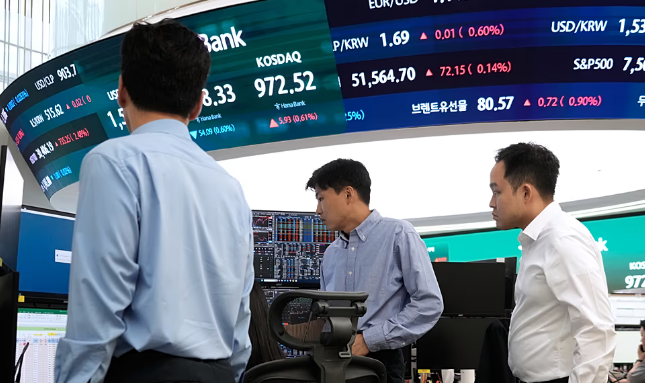
The easing of geopolitical risk helped set the tone for commodity markets, while broader financial markets in Asia delivered a mixed performance. Japanese and South Korean equities advanced, while US futures pointed lower.
Tokyo’s Nikkei 225 index rose 1.6% to 72,364.82, after briefly touching a record intraday high of 72,831.73. Gains were driven largely by technology shares, supported by continued optimism surrounding the global artificial intelligence sector. SoftBank Group, a major investor in AI-related firms, climbed 2.4%, while Tokyo Electron gained 2.3%.
South Korea’s Kospi index added 0.4% to 9,084.37, also hovering near record levels, with semiconductor stocks leading gains. Memory chip producer SK Hynix surged 4.7% amid strong demand expectations linked to AI development.
Neil Newman, managing director and head of strategy at Astris Advisory Japan, said markets remained upbeat but warned of potential overheating. “We’re seeing another strong market today,” he said, noting that Japanese equities may be becoming “a little stretched,” particularly given uncertainty in the Middle East.
Elsewhere in the region, Hong Kong’s Hang Seng index dropped 1% to 23,690.86, while China’s Shanghai Composite Index edged up 0.2% to 4,098.01.
Oil traders continue to monitor developments in US-Iran negotiations closely, with any breakdown in talks likely to revive concerns over supply security and renewed volatility in energy markets.