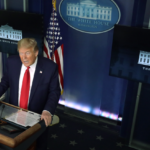


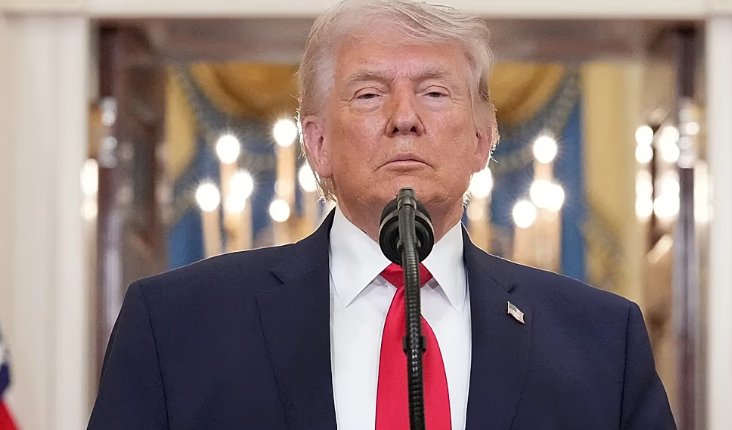
Oil rose sharply and European stocks fell after US President Donald Trump said in his first national address since the Iran war began that the United States would continue military action against Iran and “finish the job.” The remarks unsettled financial markets, with investors reacting to the absence of a clear plan to end the conflict.
Instead of outlining a path toward de-escalation, Trump signalled that attacks would continue over the next two to three weeks. “We are going to hit them extremely hard,” he said, adding that the US was close to achieving its core objectives. He also warned of further strikes on energy facilities if no agreement is reached with Tehran.
The lack of clarity over a ceasefire or diplomatic solution weighed on global markets. Brent crude briefly rose above $108 per barrel before settling near $107.70 at the European market open, while US West Texas Intermediate climbed 6.2% to around $106.30 per barrel. The gains reflect ongoing concerns about disruptions to global oil supply, particularly as the Strait of Hormuz remains a critical but uncertain route for energy shipments.
Stock markets across Europe opened lower. London’s FTSE 100 fell 0.7%, Paris’s CAC 40 dropped 1.2%, and Frankfurt’s DAX declined 1.5%. Indices in Milan and Madrid also posted losses of more than 1%. Energy companies such as ENI and TotalEnergies recorded gains of over 2%, benefiting from higher oil prices, while technology and industrial stocks, including Deutsche Telekom, Schneider Electric, and ASML, declined sharply.
Asian markets also closed in negative territory. Japan’s Nikkei 225 fell 2.4%, while South Korea’s Kospi dropped 4.5%. Hong Kong’s Hang Seng declined 1.1%, and China’s Shanghai Composite slipped 0.7%. US stock futures were also lower, pointing to potential declines on Wall Street.
Currency markets reflected the shift in sentiment, with the euro falling 0.5% against the US dollar. Precious metals also moved lower, with gold dropping 3.5% to $4,644.40 per ounce and silver falling 6.8% to $70.90.
Market analysts said investors had expected clearer signals from Washington about the direction of the conflict. “There were no concrete details about the end of the hostilities,” said Takashi Hiroki, chief strategist at Monex in Tokyo, noting that markets are seeking a defined path toward a ceasefire.
The latest market reaction highlights the sensitivity of global financial systems to geopolitical developments. With no immediate resolution in sight, traders and policymakers are closely watching how the conflict evolves and its potential impact on energy supply, inflation, and economic growth.