

In a groundbreaking medical achievement, surgeons in the United Kingdom and the United States have successfully carried out what are believed to be the world’s first remote-controlled stroke surgeries. The demonstrations, conducted on human cadavers, mark a major step toward expanding access to life-saving stroke treatments for patients in remote or underserved regions.
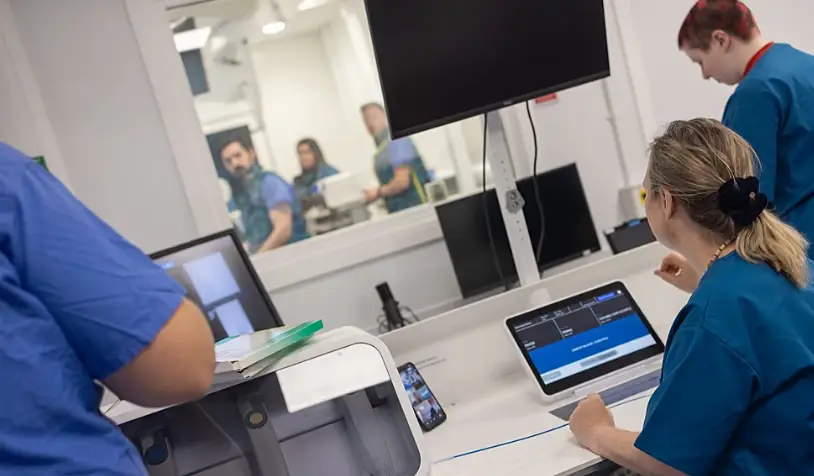
Dr Iris Grunwald, operating from Dundee, Scotland, performed a remote thrombectomy — a delicate procedure that removes blood clots from the brain to restore blood flow. The operation was carried out on a cadaver located elsewhere in the city using a robotic system developed by Lithuanian medical technology firm Sentante.
At the same time, across the Atlantic, Dr Ricardo Hanel in Jacksonville, Florida, performed a similar operation using the same technology — operating from approximately 6,500 kilometres away.
“What amazed me most was how tactile the experience was,” Dr Grunwald said after the demonstration. “My hands felt exactly as they usually would if I had been doing a conventional thrombectomy.”
The thrombectomy procedure is one of the most effective treatments for ischemic stroke, a condition caused by a blood clot blocking a vessel in the brain. Timely intervention can mean the difference between full recovery and lifelong disability. According to the World Stroke Organization, ischemic strokes claim around 3.3 million lives each year worldwide.
In Scotland, only a small fraction of patients currently receive the treatment. Sentante reported that just 212 thrombectomies were performed in the country last year — accounting for only 2.2 per cent of ischemic stroke cases.
The company believes its robotic system could help close that gap by allowing expert surgeons to perform procedures remotely, bringing specialist care to regions that lack advanced stroke centres. “For an ischemic stroke, the difference between walking out of hospital and a lifetime of disability can be just two to three hours,” said Sentante’s chief executive, Edvardas Satkauskas. “Today, patients are often transported long distances to reach one of a limited number of thrombectomy centres.”
Sentante’s technology links standard surgical instruments to a robotic interface that mimics a surgeon’s hand movements. The surgeon operates using X-ray imaging and high-definition visual feedback, while the robot replicates each motion in real time at the patient’s bedside.
Dr Hanel described the experience as “truly remarkable,” noting that operating remotely from the US to Scotland involved just a 120-millisecond delay — roughly the blink of an eye.
Both doctors said the successful demonstrations could pave the way for a new era of remote surgical care. “This shows that many more stroke patients could benefit from this potentially life-saving procedure,” Hanel said.
If validated in future clinical trials, experts say the technology could revolutionise how critical neurological surgeries are performed, saving lives by allowing faster treatment even when specialists are thousands of kilometres away.