

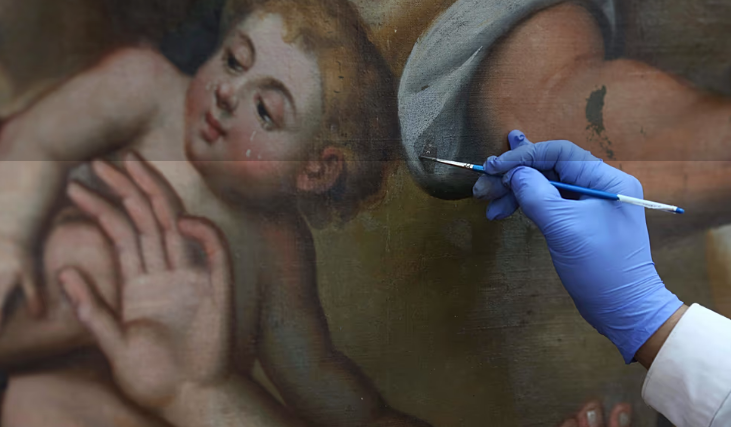
From an AI-generated mask that can restore a 15th-century painting in three hours to scientists developing eco-friendly cleaning gels from renewable materials, a new wave of technology is saving masterpieces.
Art galleries and museums often maintain extensive collections beyond their public exhibits, with damaged pieces stored and carefully restored in specialized workshops. Conservation and restoration require deep knowledge of art history, chemistry, physics, and material science. Techniques such as infrared imaging to detect lost paint beneath the surface, or selecting solvents that remove oxidized varnish without harming the artwork, are crucial to preserving historical integrity.
Researchers are now introducing tools that can dramatically accelerate and improve these processes. At the Massachusetts Institute of Technology (MIT), graduate researcher Alex Kachkine developed a method that uses artificial intelligence to restore paintings quickly and reversibly. The system analyses a damaged work, generates a digitally restored version, and prints it onto an ultra-thin polymer laminate mask. This mask is applied over the original painting, restoring its appearance without altering the underlying piece.
The method was tested on a severely damaged 15th-century oil painting, restoring over 57,000 hues in just over three hours—approximately 66 times faster than traditional techniques. Kachkine said the mask also addresses ethical concerns in restoration, as it allows retouching to be fully reversible. “Because there’s a digital record of what mask was used, in 100 years, the next time someone is working with this, they’ll have an extremely clear understanding of what was done to the painting,” he told MIT News.
Conservators and art historians remain essential in guiding the process, ensuring that interventions respect a work’s historical and artistic context.
Environmental sustainability is another focus of recent innovations. The GREENART project, funded by the European Union, has developed eco-friendly cleaning gels and protective coatings made from renewable and recycled materials. Twin-chain polyvinyl alcohol hydrogels, used at London’s Tate Britain, allowed conservators to safely clean Bridget Riley’s paintings Fall (1963) and Hesitate (1964) while reducing chemical impact. The hydrogels feature a porous structure and are combined with non-toxic, bio-based polymers to create controlled and efficient cleaning tools.
Researchers in Beijing are exploring cellulose derivatives, such as nanocellulose and cellulose ethers, as adhesives and coatings for paper, textiles, pottery, and murals. These materials are renewable, low-toxicity, and can reinforce cracks, provide water-resistant coatings, or restore fragile surfaces with precision.
As climate change, aging materials, and environmental pressures present new challenges, these technological advances are offering conservators powerful tools. Combining AI, sustainable chemistry, and interdisciplinary knowledge, the field of art restoration is entering a new era where speed, safety, and environmental responsibility can go hand in hand with preserving cultural heritage.