

German engineering group Siemens and US chipmaker Nvidia have carried out a live factory trial of a humanoid robot, marking a step toward integrating artificial intelligence into industrial production.
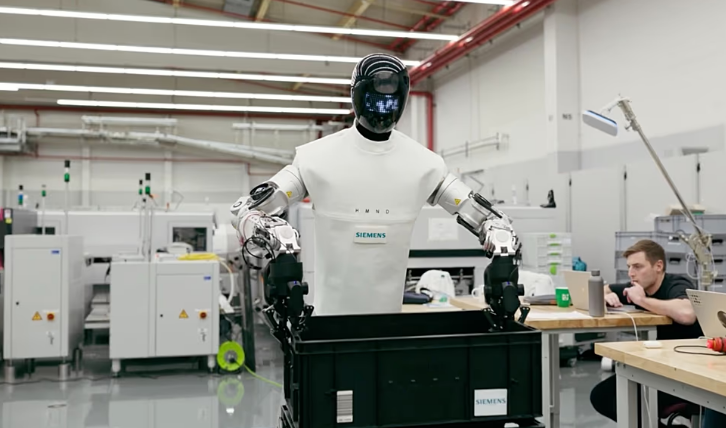
The test took place at Siemens’ electronics plant in Erlangen, where a robot developed by UK-based Humanoid was deployed to perform logistics tasks alongside human workers. The machine, known as HMND 01, was designed to handle routine operations such as picking up, transporting and placing containers used in daily factory processes.
According to Siemens, the robot operated autonomously for more than eight hours during the trial and successfully completed over 90 per cent of its assigned tasks. It handled around 60 containers per hour, demonstrating the potential for consistent performance in a real industrial environment.
The project forms part of a broader collaboration between Siemens and Nvidia aimed at developing what they describe as the world’s first fully AI-driven adaptive factories. The goal is to create production environments where machines can work alongside people, responding to changes and making decisions in real time.
Executives involved in the project said the trial highlights advances in “physical AI”, a concept that enables machines to perceive their surroundings, process information and adjust their actions without direct human control. Nvidia provided the underlying artificial intelligence technology, including simulation tools and real-time processing systems, while Siemens handled industrial integration.
The companies said much of the robot’s development was completed through virtual simulations before deployment. This approach significantly reduced the time required for testing and design, cutting development cycles from as long as two years to roughly seven months.
Industry observers say such systems could help manufacturers address labour shortages and improve efficiency in areas where traditional automation has struggled. Tasks that require flexibility, movement and interaction with human workers have historically been difficult for machines to handle, but advances in AI are beginning to close that gap.
While the trial is being described as a milestone, Siemens and Nvidia have not provided a timeline for large-scale adoption of humanoid robots in factories. Questions remain around cost, scalability and safety before the technology can be rolled out more widely.
Even so, the demonstration offers a glimpse into how manufacturing could evolve, with intelligent machines taking on more complex roles while working in coordination with human staff on the factory floor.