

Swiss scientists are trialing a semi-autonomous, four-legged robot designed to explore Mars and other planets without constant human guidance, potentially speeding up the search for minerals, water, and traces of ancient life. In recent trials, the dog-like robot completed missions three times faster than human-guided alternatives.
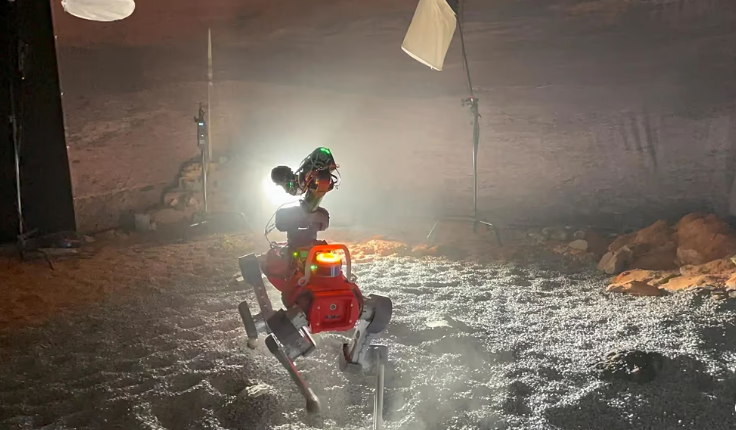
The robot, named ANYmal, resembles a robotic dog rather than a traditional wheeled rover. It is equipped with a robotic arm that holds a microscopic imager and a Raman spectrometer, a tool that reads and identifies the chemical composition of rocks.
Researchers at the University of Basel have been testing ANYmal at their “Marslabor,” a simulation facility replicating the dusty, rocky terrain of Mars and the Moon. The robot’s mission is to navigate independently, identify scientifically interesting rocks, analyze them, and transmit the results — all without direct human control.
In recent experiments published in Frontiers in Space Technologies, ANYmal successfully analyzed multiple rock samples in sequence, identifying gypsum, carbonates, basalts, and lunar-analogue materials such as dunite and anorthosite. The robot completed these missions in just 12 to 23 minutes, while human operators performing the same tasks required 41 minutes. Researchers noted that human oversight produced slightly more detailed results and marginally higher accuracy, but the time savings offered by ANYmal are substantial.
Current Mars rovers operate under near-constant supervision from Earth and typically cover only a few hundred meters per day. Robots capable of independent scientific decision-making could dramatically accelerate the pace of planetary exploration.
ANYmal’s legged design allows it to navigate challenging terrain, stepping over obstacles and adjusting to variable surfaces that wheeled rovers cannot reach. This capability could enable scientists to study areas previously inaccessible to robotic explorers, opening new possibilities for discovering minerals or other geological features.
The research suggests that future robotic explorers may not simply act as tools controlled from Earth, but as autonomous scientific participants. Robots like ANYmal could actively search for biosignatures — chemical traces that hint at ancient life — and perform complex analyses without waiting for human input.
The study demonstrates the potential of semi-autonomous, legged robots for accelerating planetary science, offering a new approach to exploring Mars, the Moon, and potentially distant exoplanets. By combining speed, autonomy, and advanced sensing tools, these robots may soon play a central role in humanity’s quest to understand the cosmos.