

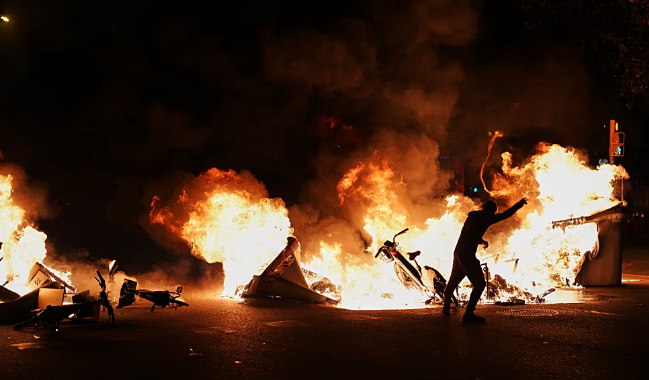
More than 70 people were arrested after riot police clashed with masked protesters in Madrid and Barcelona during Spain’s first general strike in 14 years, as hundreds of thousands took to the streets to demand action on rising housing costs and low wages.
The 24-hour stoppage began at midnight on Wednesday under the slogan “Wages, housing and prices”. Despite heavy rain, demonstrations took place across the country, with protesters gathering in major cities to highlight the growing pressure on household finances.
In Madrid, demonstrators chanted slogans, danced and held keys aloft as they marched through the capital. Police confronted groups of masked protesters in Madrid and Barcelona, with the clashes resulting in more than 70 arrests.
The strike was backed by Spain’s two largest trade unions, Comisiones Obreras (CCOO) and the General Union of Workers (UGT), alongside smaller unions CGT and CNT and other organisations. It marked the first major mobilisation by the main unions since 2012, when conservative Prime Minister Mariano Rajoy was in office.
It was also the eighth general strike since Spain returned to democracy in the late 1970s.
Estimates of participation differed sharply between organisers and authorities. In Madrid, the Tenants’ Union, known as Sindicato de Inquilinas, estimated that more than 500,000 people joined the demonstration. The central government’s office in the city put the figure at 120,000.
In Barcelona, organisers reported 400,000 participants, while city police estimated the crowd at 55,000. Municipal police in the northern city of Bilbao recorded around 50,000 demonstrators.
Housing costs at the centre of protests
The housing crisis has become a major concern, particularly for younger people struggling to find affordable accommodation. Rents have increased by around 80% over the past decade, while wages have failed to keep pace with the rising cost of living.
Protest organisers said the demonstrations were directed at national, regional and local authorities, regardless of political affiliation. They accused governments at all levels of failing to take effective measures to address housing affordability and stagnant incomes.
The strike brought together workers, tenants and campaign groups seeking better wages, lower living costs and greater access to affordable housing.
However, unions and employers offered opposing assessments of the walkout, reflecting divisions over its impact and the demands behind the mobilisation. The scale of participation across several major cities showed the extent of public concern over housing costs and the pressure on wages.