
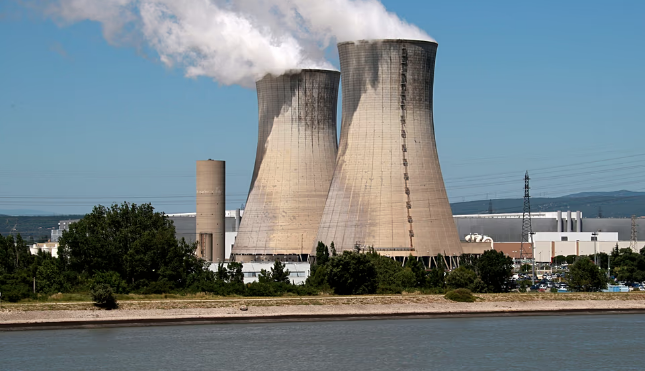
France’s state-owned energy company EDF has temporarily shut down three nuclear reactors and warned that seven others could operate at reduced power as an intense heatwave continues to grip the country, forcing the utility to comply with environmental regulations designed to protect rivers and aquatic ecosystems.
The reactors were taken offline because the plants use river water to cool their systems before returning the heated water to nearby waterways. With river temperatures already elevated by extreme weather, EDF said continuing normal operations could push water temperatures beyond permitted environmental limits.
“There is no nuclear safety risk. Reactors are capable of operating under high-temperature conditions. These limits are intended to protect aquatic flora and fauna,” an EDF spokesperson said.
The reactors currently out of service include Unit 2 at the Golfech nuclear plant with a capacity of 1,300 megawatts, Unit 3 at the Bugey plant producing 900 megawatts, and Unit 2 at the Chooz facility with a capacity of 1,450 megawatts. Together, the three reactors account for about 3.65 gigawatts, representing roughly six percent of France’s installed nuclear generation capacity of around 61 gigawatts.
EDF said the reactors are expected to remain offline until weather conditions improve, based on current forecasts. Bugey Unit 3 is scheduled to restart on July 19, Golfech Unit 2 on July 22, and Chooz Unit 2 on July 25. The company noted that these dates could change if weather forecasts are revised.
In addition to the shutdowns, EDF said seven other reactors may have to adjust their electricity output throughout the day to remain within environmental limits.
France’s Economy Ministry has already granted a temporary exemption for water temperature limits at the Bugey plant on the Rhône River until July 20, citing the need to maintain electricity supply and protect the stability of the national power grid.
The current shutdowns mark the second time in recent weeks that EDF has been forced to reduce nuclear generation because of extreme heat. France experienced another record-breaking heatwave in June, highlighting the increasing challenges climate conditions pose to electricity production.
Despite the disruptions, EDF said the long-term impact of heatwaves and droughts on nuclear generation has remained relatively small. Since 2000, production losses linked to high river temperatures and reduced water flows have averaged only 0.3 percent of the French nuclear fleet’s annual electricity output.
The company is also investing in long-term climate adaptation measures. Earlier this year, EDF announced an €8.7 billion plan to strengthen the resilience of its nuclear, hydropower and island energy operations over the next 15 years.
Among the measures under consideration are systems that cool discharged water before it is released into rivers, a technology already in use at the Civaux Nuclear Power Plant. EDF is also working to improve flood management, maintain hydropower production during periods of low river flow, and reinforce electricity networks serving France’s island territories against increasingly severe weather conditions.