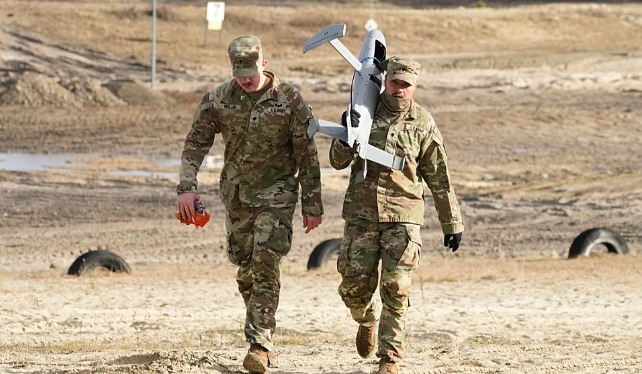
NATO is stepping up efforts to develop faster and more affordable ways to counter the growing threat posed by drones, bringing military commanders and defence companies together to identify new technologies that can better protect allied airspace.
The alliance’s second AIRCOM Industry Day, held at Ramstein Air Base in Germany, gathered representatives from European defence firms, military officials and security experts to discuss counter-drone solutions as unmanned aerial systems become an increasingly common feature of modern warfare.
The urgency has grown following several recent incidents involving drones near NATO territory, including one that crashed into a house in Romania, another that entered Lithuanian airspace, and a suspected drone sighting that temporarily disrupted operations at Munich Airport.
When an unidentified drone enters NATO airspace, the alliance activates Operation Eastern Sentry, deploying fighter aircraft to monitor or intercept the threat if necessary. Military officials acknowledge that this approach is expensive, as scrambling fighter jets can cost tens of thousands of euros per hour, while many drones can be produced for less than €100,000.
Lieutenant General Guillaume Thomas, Deputy Commander of Allied Air Command, said the widespread use of drones in conflicts, particularly in Ukraine, has created new challenges for NATO. He said the alliance must remain ahead in production capacity, innovation and cost efficiency through closer cooperation with industry.
Security experts also highlighted lessons from the war in Ukraine. Dr. Ulrike Franke of the European Council on Foreign Relations said drones have transformed modern battlefields by allowing large-scale, low-cost attacks. She argued that NATO must avoid relying on expensive systems to defeat inexpensive drones and continue learning from Ukraine’s battlefield experience.
Senior Lieutenant Oleksandr Vorobiov of Ukraine’s 3rd Army Corps said one of Ukraine’s biggest challenges remains reliable radar detection. Existing radar systems often struggle to continuously track small drones, preventing interceptor drones from operating fully autonomously and forcing operators to take manual control.
Lieutenant Colonel Steffen Bott, the event’s project manager, said the purpose of Industry Day was to connect military requirements with rapidly evolving technologies. He noted that while NATO does not purchase equipment directly, the alliance helps identify operational needs and encourages cooperation with defence manufacturers.
Around 35 companies displayed counter-drone technologies during the event, including radar systems, interceptor drones and specialised missiles. Defence manufacturer MBDA presented a missile designed to counter large-scale drone attacks at a lower cost. The missile is being integrated into Rheinmetall’s Skyranger 30 air defence system, which Germany plans to deploy with its brigade in Lithuania between 2027 and 2028.
Although Ukrainian companies did not participate because the exhibition was limited to firms from NATO member states, Ukraine remained central to discussions. Several exhibitors said they have worked closely with Ukrainian forces to improve artificial intelligence, surveillance systems and drone interception technologies based on battlefield experience.
Industry representatives said demand for effective counter-drone systems is expected to grow rapidly as NATO members continue strengthening their air defence capabilities in response to evolving security threats.