
Wall Street’s most recognised stock-market label, the “Magnificent 7,” is beginning to evolve as investors adjust to a rapidly expanding artificial intelligence boom that now stretches well beyond its original technology giants.
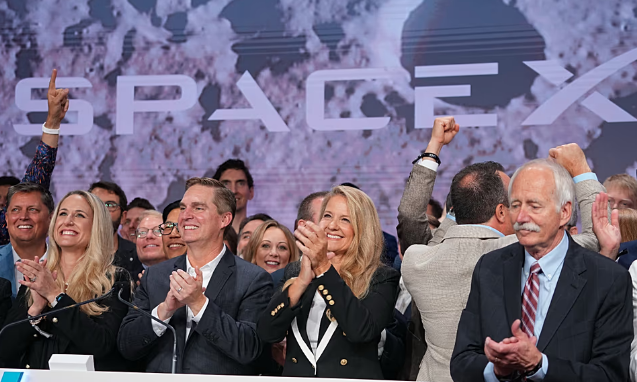
Following SpaceX’s record-breaking market debut, strategists have started grouping Elon Musk’s aerospace and AI company alongside OpenAI and Anthropic into a new classification dubbed the “FAB 10,” signalling what some analysts describe as the next phase of the AI-driven equity rally.
The term, coined by British financial research firm Vanda Research, stands for “Frontier AI & Big Tech 10.” It retains the original seven megacap companies—Nvidia, Apple, Microsoft, Alphabet, Amazon, Meta and Tesla—while adding SpaceX and the two leading AI model developers, OpenAI and Anthropic. The grouping reflects a broader attempt to capture shifting investor attention as capital flows increasingly favour AI infrastructure, models and platforms.
SpaceX’s inclusion follows a strong market debut that has already propelled the company into the ranks of the world’s largest firms by valuation. After closing above $192 per share on Monday, the company has climbed to become the sixth most valuable listed entity globally, underscoring investor enthusiasm for its Starlink satellite network and growing artificial intelligence ambitions.
The original “Magnificent 7” label was introduced in late 2023 by strategist Michael Hartnett to describe the handful of technology giants driving equity markets to record highs. Together, those seven companies now carry a combined valuation of roughly $22.6 trillion, with Nvidia alone exceeding $5 trillion in market capitalisation.
The newly proposed additions represent a broader expansion of the AI ecosystem. SpaceX brings aerospace infrastructure and global satellite connectivity, while OpenAI and Anthropic are viewed as frontrunners in the development of frontier artificial intelligence models that are reshaping software, productivity and enterprise systems.
Vanda Research said the emergence of the “FAB 10” reflects how investor focus is shifting from a narrow group of megacap tech stocks toward a wider network of companies expected to define the next decade of technological growth.
However, the grouping also highlights a structural complication: both OpenAI and Anthropic remain private companies, although each has signalled potential moves toward public listings later this year. Analysts estimate that future valuations could exceed $1 trillion, further blurring the line between public equity benchmarks and private-market leaders.
Other market strategists have proposed alternative frameworks, including Bank of America’s “AI Big 10,” which adds semiconductor firms such as Broadcom, AMD and Micron. Another informal grouping, sometimes referred to as “MANGOS,” also circulates among investors, combining leading AI and tech players under different configurations.
Despite the emergence of new labels, strategists stress that the original “Magnificent 7” remains central to market performance, still accounting for roughly one-third of the S&P 500’s total value. Rather than replacing existing leaders, the new classifications reflect a widening landscape in which more companies are seen as critical to the AI-driven market cycle.