

Germany’s air ambulance operators are warning that proposed legislation to limit health insurance spending could place pressure on emergency helicopter services, raising concerns about the future of rapid medical transport, particularly in rural areas.
The federal government’s proposed GKV Contribution Rate Stabilisation Act aims to control rising healthcare costs by limiting reimbursement increases for healthcare providers. Air rescue organisations argue the plan would not adequately reflect the rising costs of operating helicopters, maintaining aircraft and employing highly trained medical crews.
Air ambulance services play a critical role in Germany’s emergency healthcare system by complementing ground ambulances rather than replacing them. Helicopters are frequently dispatched to serious traffic accidents, heart attacks, strokes and other life-threatening emergencies where every minute can affect a patient’s chances of survival. They are also used to transfer critically ill patients between hospitals when specialist treatment is available only at selected medical centres.
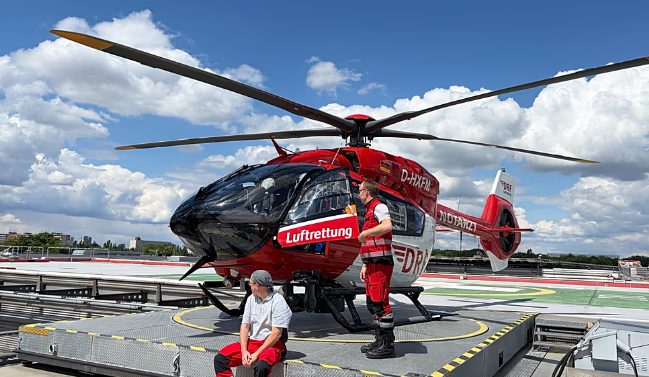
At Berlin Accident Hospital in Marzahn, the “Christoph Berlin” helicopter operates around the clock with a crew consisting of a pilot, an emergency physician and an emergency paramedic. Once an emergency call is received, the aircraft can normally take off within two minutes.
Emergency physician Jan Martin said rapid response is particularly important for patients suffering heart attacks or strokes.
“When an emergency call comes in, every moment counts. With heart attacks or strokes, tissue is lost with every minute that passes without treatment,” he said.
Germany’s DRF Luftrettung operates 34 helicopter bases across 32 locations, including three in Berlin. A helicopter can travel approximately 70 kilometres in about 17 minutes, allowing medical teams to reach patients or specialist hospitals much faster than road transport in many cases.
The service requires substantial resources. Helicopters cost several million euros to purchase and equip, while each flight hour consumes roughly 280 litres of aviation fuel. Operators must also maintain aircraft, employ specialised flight crews and keep teams available around the clock, regardless of how many emergency calls are received.
Modern helicopters are equipped with advanced medical technology, including blood and plasma supplies that enable life-saving treatment to begin before patients reach hospital.
DRF Luftrettung Managing Director Dr. Krystian Pracz said operators are currently reimbursed according to flying time, with payments intended to cover the full cost of maintaining continuous emergency readiness.
He argued that faster medical intervention can also reduce long-term healthcare costs by improving patient outcomes and shortening recovery times.
The proposed legislation would link reimbursement increases to wage growth or actual cost increases, depending on which is lower. Air rescue organisations, including DRF Luftrettung, ADAC Luftrettung and Johanniter, say the formula would create a funding shortfall because operating costs have risen faster than those benchmarks.
Emergency paramedic Mathias Buchholz said helicopter transport also helps preserve emergency response capacity by allowing ground-based doctors and ambulances to return to their service areas more quickly.
The German parliament is expected to vote on the proposed healthcare savings package on July 10. Air rescue providers say the outcome could have significant implications for emergency medical services, particularly in rural regions where specialist hospitals are often located far from patients requiring urgent care.