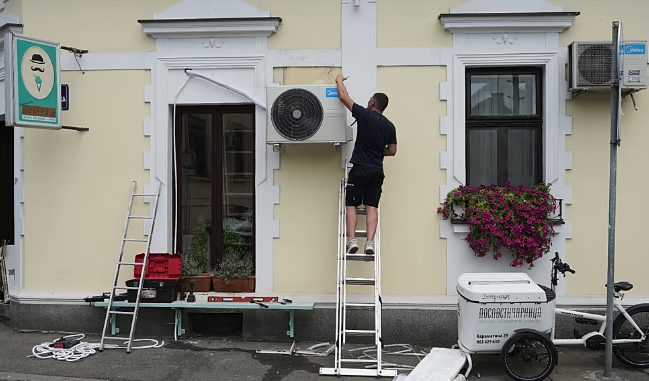
Household air conditioning prevents more than 5,000 heat-related deaths each year in the United States, according to a new study that highlights the growing importance of access to cooling as temperatures rise.
Research published Monday in Nature Health found that home air conditioning prevents an estimated 5,260 heat-related deaths annually in the US. The researchers said household cooling reduces heat-related mortality by more than half.
The study was conducted by researchers from the Yale School of Public Health and the Yale School of the Environment. They examined nearly 30 million death records covering the period from 2010 to 2020 and compared deaths with daily temperatures in the counties where people lived.
Researchers then examined electricity consumption linked to household cooling in each county to assess how actual air-conditioning use affected heat-related deaths.
Kai Chen, senior author of the study and an associate professor of epidemiology at Yale School of Public Health, said the research was designed to measure the number of deaths prevented across an entire population rather than simply establish that air conditioning protects individuals from heat.
The findings also challenge the idea that maximum cooling provides the greatest health protection. Researchers found that using air conditioning at very high levels did not offer additional health benefits compared with average use.
That finding points to the need for a balance between protecting people from dangerous heat and limiting the environmental impact of excessive cooling. Heavy air-conditioning use can increase electricity demand, energy costs and greenhouse gas emissions.
Cost remains a barrier
The researchers focused on actual household cooling rather than simply whether homes had air-conditioning equipment. Chen said ownership does not show whether a household can afford to operate the system or how frequently it is used.
The issue is particularly important for lower-income households, which may face difficult choices during periods of extreme heat.
Narasimha Rao, a study co-author and professor of energy systems at Yale, said some households may choose to use air conditioning while others may tolerate uncomfortable temperatures because they need to save money for essentials such as food.
The researchers said their findings could also influence housing policy. Robert Dubrow, a study co-author and founding faculty director of the Yale Center on Climate Change and Health, said landlords in the US are generally required to provide heating during winter and argued that access to cooling should receive similar consideration during summer.
The findings arrive as governments in Europe debate how best to protect people from increasingly intense heat. European countries have faced temperatures above 40°C during recent heatwaves, prompting political disputes over wider use of air conditioning.
The European Commission has backed a broader strategy that includes better building design, insulation, passive cooling methods and more efficient air-conditioning systems where necessary.
The Yale research suggests that while cooling can save lives, access to it and the ability to afford its use remain important parts of the response to extreme heat.