


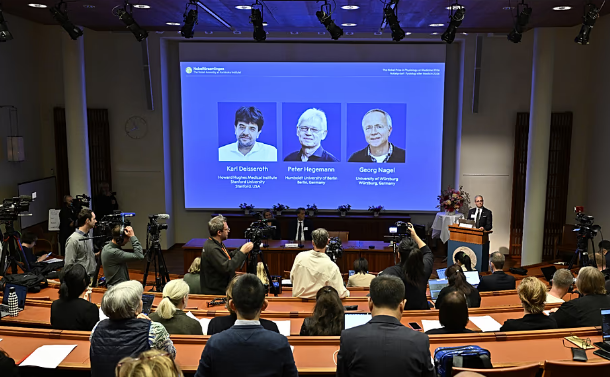
Scientists Karl Deisseroth, Peter Hegemann and Georg Nagel have been awarded the 2026 Nobel Prize in Physiology or Medicine for their work on light-gated ion channels and optogenetics, a technique that has transformed the study of the brain.
The Nobel Assembly at Karolinska Institutet announced the award on Monday, describing the work as laying the foundation for a new era in neuroscience.
Optogenetics allows researchers to control selected cells using light, effectively providing a remote switch that can turn specific cells on or off. The technique has enabled scientists to investigate how individual neurons and neural circuits influence behaviour in living animals.
The origins of the discovery date back to Hegemann’s research more than three decades ago. While studying the single-celled alga Chlamydomonas, which moves towards light, he sought to understand how the organism detects changes in illumination.
Hegemann focused on the alga’s eyespot, a small light-sensing structure on its surface. His research and subsequent experiments identified light-sensitive proteins known as channelrhodopsins.
Hegemann later worked with Nagel at the Max Planck Institute for Biophysics in Frankfurt. The researchers inserted genes from the algae into frog egg cells and human kidney cells, demonstrating that channelrhodopsin functions as a light-controlled ion channel.
When exposed to blue light, the channel can open within about 0.2 milliseconds. Positively charged ions then enter the cell, generating an electrical signal.
Deisseroth later adapted the discovery for neuroscience. He introduced the channelrhodopsin gene into rat nerve cells and showed that blue light could activate the cells and trigger nerve signals.
He subsequently used the technique in the brains of living mice, demonstrating that researchers could control specific groups of neurons with light. Experiments showed that stimulating selected neural circuits could produce physical responses, including movements of a mouse’s whiskers, or cause sleeping animals to wake.
The method was named optogenetics in 2006 and has since become an important research tool in neuroscience.
Researchers now use it to establish direct links between neural activity and behaviour. By activating or silencing particular groups of cells, scientists can study circuits associated with fear, anxiety, reward, pain, thirst, attention and aggression.
The technique has also been used in research into conditions including depression, schizophrenia, anxiety, Alzheimer’s disease, Parkinson’s disease and epilepsy.
Per Svenningsson, chair of the Nobel Committee for Physiology or Medicine, said the discovery provides opportunities to map the brain in ways researchers could previously only imagine.
Optogenetics has also moved beyond laboratory research. Scientists are testing its potential as a treatment for retinitis pigmentosa, a genetic disorder that causes blindness through the loss of light-sensitive retinal cells.
In experimental treatments, researchers introduce genes encoding light-sensitive proteins into surviving retinal cells. In some trials, patients using specialised light-emitting goggles have been able to regain partial vision and detect high-contrast objects.
The Nobel award recognises a discovery that has given researchers an unprecedented way to investigate the relationship between brain cells, neural circuits and behaviour.