

European Union foreign ministers agreed on Monday to establish a new civilian and military mission in Lebanon to strengthen the country’s security forces ahead of the planned end of the United Nations peacekeeping operation later this year.
The proposed mission will focus on border and maritime security, counter-drone operations and training for Lebanese security personnel. Its staffing levels, participating countries and command structure have yet to be finalised, although EU officials are considering a deployment of around 150 personnel.
EU foreign policy chief Kaja Kallas said the mission could begin operating on the ground within a few months.
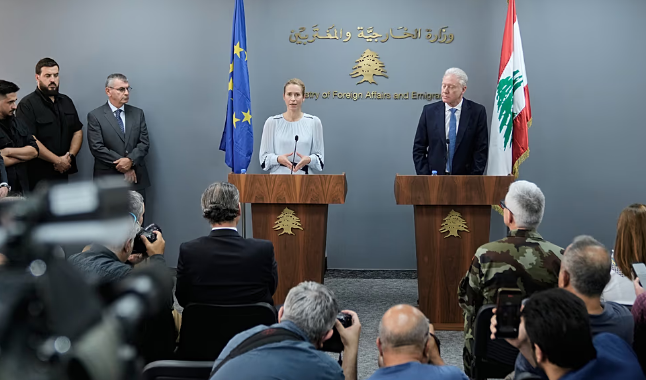
“We will establish a new mission in Lebanon. It has a civilian and military pillar,” Kallas said ahead of the Foreign Affairs Council meeting in Luxembourg.
She added that Lebanese authorities had welcomed the proposal during her visit to the country the previous week.
The initiative comes as the United Nations Interim Force in Lebanon (UNIFIL) approaches the end of its mandate in December 2026. The force has served for decades as a buffer between Israel and Lebanon, but its planned withdrawal has raised concerns about the country’s future security arrangements.
Lebanese President Joseph Aoun has called for UNIFIL’s mandate to be extended. Israel has repeatedly criticised the force for failing to contain Hezbollah, the Iran-backed armed group, while the United States has questioned its effectiveness and favoured a security arrangement directly between Israel and Lebanon.
The EU has stressed that its new mission is not intended to replace UNIFIL. Instead, it will focus on building Lebanon’s own security capabilities and supporting national authorities. The proposed deployment will not operate in southern Lebanon, where Israel continues its military campaign against Hezbollah.
French Minister for Europe and Foreign Affairs Jean-Noël Barrot said the mission would have a mandate of up to three years.
Its responsibilities would include strengthening border controls, protecting maritime security and combating drones. Both the civilian and military components would also support Lebanese police in their daily duties, he said.
The mission is expected to operate under the EU’s Common Security and Defence Policy, with member states contributing personnel and equipment on a voluntary basis.
Several countries that currently contribute to UNIFIL, including Italy, France, Spain, Ireland, Germany, Austria, Finland and Poland, have expressed interest in maintaining a presence in Lebanon. One proposal under consideration would rotate command leadership among Italy, France and Spain.
In June, French President Emmanuel Macron and Italian Prime Minister Giorgia Meloni announced plans for a joint international coalition to support Lebanon after UNIFIL’s withdrawal. It remains unclear whether that initiative will operate separately from the EU mission or become part of it.
Ireland has also indicated its intention to participate. Foreign Minister Helen McEntee said Dublin was prepared to contribute to the civilian component, although legal reforms governing overseas military deployments could complicate its involvement in the military element.
McEntee said Ireland had supported Lebanon’s armed forces and civilian population for decades and stressed the importance of maintaining that commitment.