


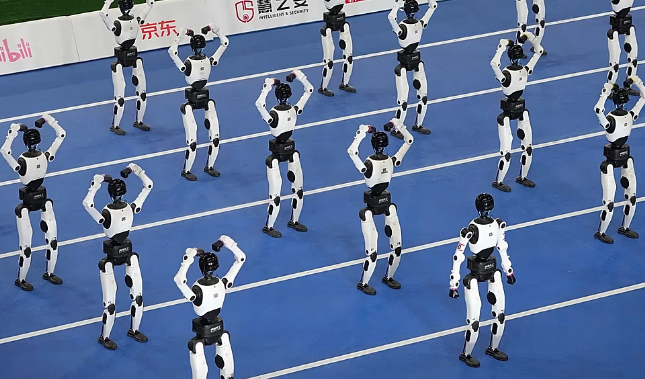
A Chinese humanoid robot has stunned spectators at the World Humanoid Robot Games in Beijing after completing the 100 metres in 9.39 seconds, faster than Usain Bolt’s long-standing human world record.
The robot, known as TienKung, was developed by the Beijing Centre for Humanoid Robotics and recorded the time during the competition on Saturday. Bolt set the men’s 100-metre world record of 9.58 seconds at the 2009 World Championships in Berlin.
Organisers described the robot’s performance as a major demonstration of the rapid progress being made in humanoid robotics, particularly in China.
“In one year alone the robots competing have become twice as fast,” the organisers said in a post on X. They noted that the winning time at last year’s event was 21.50 seconds.
The sharp improvement has drawn attention to the speed at which robotics companies are developing machines capable of performing tasks traditionally associated with humans.
The World Humanoid Robot Games are being held at Beijing’s National Speed Skating Oval, known as the “Ice Ribbon”. The second edition has attracted 666 teams and 2,056 robots from 16 countries.
Competitors are taking part in a wide range of events, including athletics, boxing, football, weightlifting and gymnastics.
Videos from the competition have spread across social media, with some clips showing robots struggling to remain upright or falling backwards after completing races. While the footage has attracted plenty of humour from viewers, organisers said the underlying technological progress should not be underestimated.
They said robots had been “slow, ponderous machines” at the inaugural games, with many struggling to finish sprint events. The latest performances, they argued, show how quickly the technology is developing.
China has placed humanoid robots among its strategic emerging industries, with companies and government officials increasingly focused on advancing artificial intelligence, robotics hardware and automated systems.
The rapid progress has also attracted significant interest from investors. Research from Morgan Stanley has estimated that the global humanoid robotics market could eventually reach $5 trillion by 2050.
The financial services group has also projected that more than one billion humanoid robots could be operating worldwide by that year.
China is expected to account for a substantial share of that growth. Morgan Stanley estimates that around 302.3 million humanoid robots could be in use in China by 2050.
The performance in Beijing adds to growing evidence of how quickly humanoid robots are improving, although their ability to match humans in everyday tasks remains a much larger challenge than setting a sprint time.