

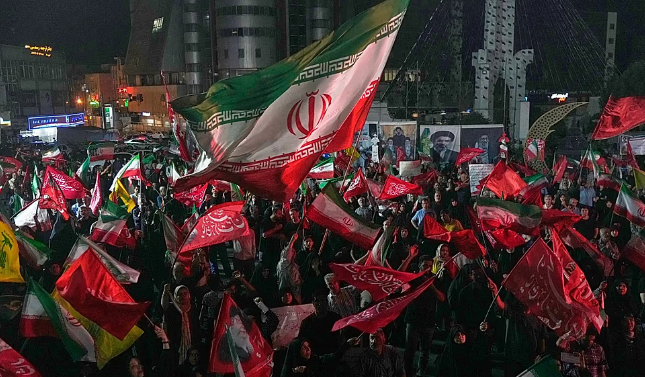
The United States carried out a seventh consecutive night of strikes against Iran on Friday, while Tehran reportedly responded with attacks on US allies and military facilities across the region, raising fears that the conflict could widen.
US Central Command said its forces targeted surveillance sites, military logistics infrastructure, underground weapons storage facilities and maritime capabilities during the latest operations.
The military said fighter jets, drones and warships were involved in the strikes and released video footage that it said showed parts of the operation.
“CENTCOM continues to hold Iran accountable at the Commander in Chief’s direction while fully enforcing a naval blockade against Iranian ports,” the command said in a statement posted on X.
Iranian state news agency Fars reported that Iranian forces responded by attacking US allies and bases in the region. The report said targets included the Ali Al Salem airbase in Kuwait as well as several communications sites in Bahrain.
Kuwait’s army said on Saturday that its air defence systems were responding to “hostile missile and drone attacks.” Jordan’s military was also reported to have intercepted 10 Iranian missiles early on Saturday.
The latest exchange came as tensions continued to rise around the Strait of Hormuz, a crucial route for global oil and gas shipments. Shipping traffic through the waterway has remained at reduced levels during the conflict, adding to uncertainty in international energy markets.
The strait has become a major point of confrontation between Washington and Tehran since the conflict began in February. Iran effectively closed the waterway after hostilities broke out, disrupting a route through which a significant share of the world’s energy supplies normally passes.
A provisional agreement reached in June had appeared to offer a path toward reopening the passage and reducing tensions. Under the terms of the memorandum of understanding, the United States was expected to end its naval blockade of Iran, while Tehran would reopen the Strait of Hormuz and reaffirm that it would not acquire or develop nuclear weapons.
The agreement also called for both sides to halt hostilities and gave them 60 days to negotiate a permanent settlement.
However, renewed military action has put those efforts under severe strain. The latest US strikes and Iranian attacks on regional targets suggest that the ceasefire framework has failed to prevent a fresh escalation.
The continuing violence has also raised concerns among governments across the Middle East, as military facilities, infrastructure and airspace in several countries have been affected by the widening confrontation.
With US forces maintaining pressure on Iran and Tehran responding against American interests and allies, the conflict remains a major threat to regional security and global energy markets.