Italy has entered a decisive phase of local elections, with mayoral and municipal council votes taking place across hundreds of cities and towns, offering a significant political test for Prime Minister Giorgia Meloni and her right-wing coalition following recent setbacks at the national level.
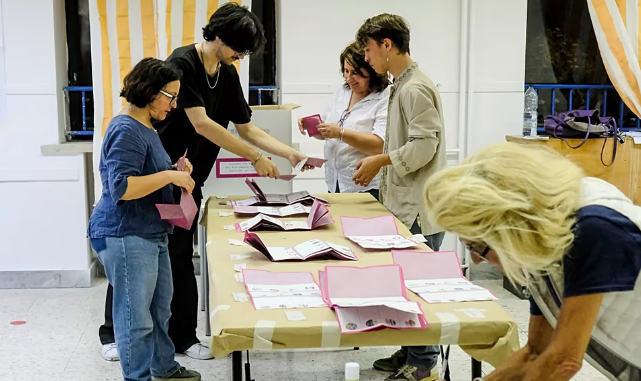
Voting resumed on Monday after the first round was held on Sunday, covering 749 municipalities. More than six million citizens are eligible to participate, with ballots being cast in around 700 areas, including the regional capital Venice and 15 provincial capitals such as Messina, Salerno, Reggio Calabria and Mantua.
Early figures showed turnout at approximately 46.5%, slightly below the 50.1% recorded in the previous comparable election cycle, according to local reports. Election officials noted that participation levels will be closely monitored as a gauge of public engagement ahead of Italy’s next general election, expected in 2027.
In municipalities with more than 15,000 residents, run-off votes are scheduled for 7 and 8 June, while Sardinia will also hold voting across 149 municipalities, with its own run-offs set for later in June.
The elections come at a sensitive moment for Meloni’s government, following a recent defeat in a referendum on justice reforms in March, which has raised questions about the durability of her political momentum. Analysts say the local results could either reinforce the governing coalition’s standing or signal deeper challenges ahead.
The contest is also seen as a measure of strength for the opposition “broad camp,” which remains fragmented across regions and cities. Alliances vary widely, with centrist parties such as Azione aligning with the centre-right in some municipalities while remaining divided from centre-left partners elsewhere.
Attention is focused on 118 larger municipalities where political competition is most intense. In Venice, the centre-left is attempting to regain control after a decade of centre-right administration under Mayor Luigi Brugnaro. In contrast, in Reggio Calabria, the centre-right is seeking to reclaim influence following the tenure of Democrat-backed leadership under Giuseppe Falcomatà.
Other closely watched races include Crotone and Salerno, where local dynamics and independent civic candidates are shaping unpredictable contests. The presence of former regional governor Vincenzo De Luca’s civic list has added further complexity to an already divided progressive bloc.
As campaigns draw to a close, both governing and opposition coalitions are treating the results as a barometer of national sentiment. The outcomes in key cities are expected to influence political narratives in the months ahead, potentially reshaping alliances and strategies before Italy’s next general election.